COLUMN / When Hundreds of Beavers don’t linger, and that’s the point
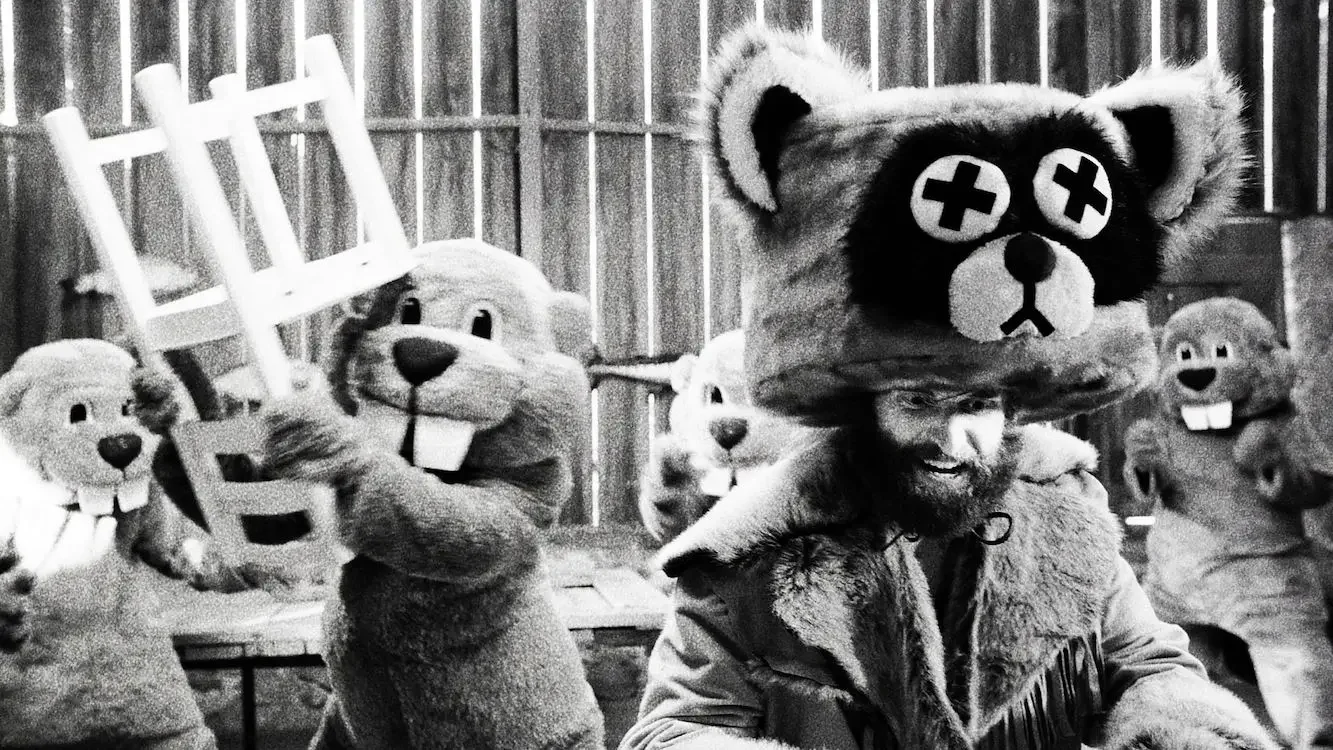
In her bi-weekly film column, Liza Kolomiiets explores films that spark a thought, raise a question or simply offer an unusual way of looking at cinema. This time, she takes on Mike Cheslik’s Hundreds of Beavers (2022), a wildly absurd silent comedy that is finally reaching Dutch cinemas in 2026, four years after its initial premiere.
When I invited a friend to watch a film where a man tries to hunt down beavers, who are actually just people in costumes, the first thing he asked me was what kind of fever dream I was inviting him to before initiating the conversation. However, since many sources have called the film ‘a new cult classic’, my invitation was eventually accepted, and our expectations had significantly risen. The film in question was the black-and-white silent film Hundreds of Beavers (2022) by American director Mike Cheslik.
“Some films demand to be discussed, analysed and remembered. Others simply take you somewhere strange for two hours and let you leave when the ride is over, and there is something surprisingly enjoyable about it.”
Some fever dreams linger for weeks to come. Some take you on a crazy ride, but once it is over, they vanish from your consciousness as soon as something else comes along. Hundreds of Beavers turned out to be the latter. This might sound negative at first, but it made me think about what we expect films to leave behind. Some films demand to be discussed, analysed and remembered. Others simply take you somewhere strange for two hours and let you leave when the ride is over, and there is something surprisingly enjoyable about it.
The film tells the story of Jean Kayak (Ryland Tews), a successful applejack brewer whose careless and drunken days end when a colony of extremely clever beavers spills his entire supply, burns down his apple orchard, destroys his house, and knocks him unconscious. When Jean wakes up covered in snow and completely disoriented, his hero’s journey begins. He needs to survive the winter while battling the various animals in his surroundings. At the same time, he is on a mission to prove his worthiness to the Merchant, whose daughter Jean instantly fell for.
The plot itself might be quite familiar, sitting somewhere between a parody of Alejandro G. Iñárritu’s The Revenant (2015) and a medieval tale. Still, the film remains a wild ride for most of its duration. From BDSM-strapped disappearing dogs to an indigenous man trying to ride his horse, who is yet again just a dude in a horse costume, the film keeps introducing increasingly farcical situations.
Next to all the strategically minded animals, Jean looks ridiculously silly, which provides the main basis for most of the visual slapstick comedy. Clearly inspired by silent film comedies, video-game challenges, and golden-age animation where the rules of gravity were not yet invented, Cheslik tries relentlessly to make the viewer laugh. Some of it is genuinely funny. A lot of it is repetition. Unless you were under some influence, just as my friend initially speculated, not that many jokes made people in the cinema, myself included, laugh out loud.
The choice to film Hundreds of Beavers in black and white gives the film a visual consistency, even when almost nothing else makes sense. It also allows for the simple pleasure of watching a black-and-white film on a big screen. A few times, the film even surprises the viewer with genuinely stunning and creative shots, such as Jean climbing a tree under a starry sky or hundreds of beavers chasing him across the landscape. Together with the old-school sound effects made with wooden kazoos and clapper toys, and the original score composed by Wayne Tews, father of the lead actor, Cheslik creates an experience that sits somewhere between William Hanna’s Tom and Jerry and Buster Keaton’s Steamboat Bill, Jr. (1928).
Nevertheless, the film would probably have been sharper if Cheslik had killed a few darlings. At nearly two hours, some of the repetition starts to wear thin, especially when a joke that was funny the first time comes back again and again without much advancement. Still, there is something admirable about a film that commits so completely to its own absurdity.
“Shooting took twelve weeks, while post-production took nearly two years to complete. More than 1,500 special effects were created in Adobe After Effects.”
That commitment becomes even clearer when looking at how the film was made. The initial budget was enough to film the first act, which helped the filmmakers find more investors and eventually reach a budget of $150,000. That is not a lot if you actually want to pay everyone involved in making a feature film, including all the beavers. The filming crew consisted of only six people. Shooting took twelve weeks, while post-production took nearly two years to complete. More than 1,500 special effects were created in Adobe After Effects. The filmmakers also insisted on self-distribution so the film could be seen in cinemas rather than being almost immediately sent to video-on-demand by distributors.
For all its absurdity, Hundreds of Beavers is a reminder of how much can still be done with very little. A tiny crew made a feature film about a man hunting hundreds of people dressed as beavers. They built an entire visual language around costumes, practical effects, editing, sound effects, and animation. It is difficult to watch the film and think that cinema has run out of things to try.
The famous quote by John Bunyan, ‘It is always hard to see the purpose in wilderness wanderings until after they are over’, appears very early in the film. It was most likely placed there as a grounding idea for everything that follows, yet it also captured something about the experience of watching Hundreds of Beavers. Jean spends the film wandering through an increasingly absurd wilderness, learning its rules and figuring out how to survive it. As viewers, we do something similar. We spend almost two hours following a ridiculous journey without necessarily needing it to lead anywhere profound.
I did not debate Hundreds of Beavers with my friend for hours after watching it. It is unlikely to be one of those films that stays in my head for weeks. We enjoyed it, laughed at some of it, questioned some of it, and moved on soon after. And perhaps that is enough. In times when almost everything seems to demand an opinion, an analysis, or a discussion, there is something refreshing about a film that simply takes you somewhere completely ridiculous and then lets you go.
Liza Kolomiiets is a Ukrainian researcher and critic based in the Netherlands, working across film, fine art, and media. Her work focuses on themes of displacement and exile, while her curiosity extends to a wide range of visual forms and artistic expressions.