Haribo Kimchi: Cultures on Stage
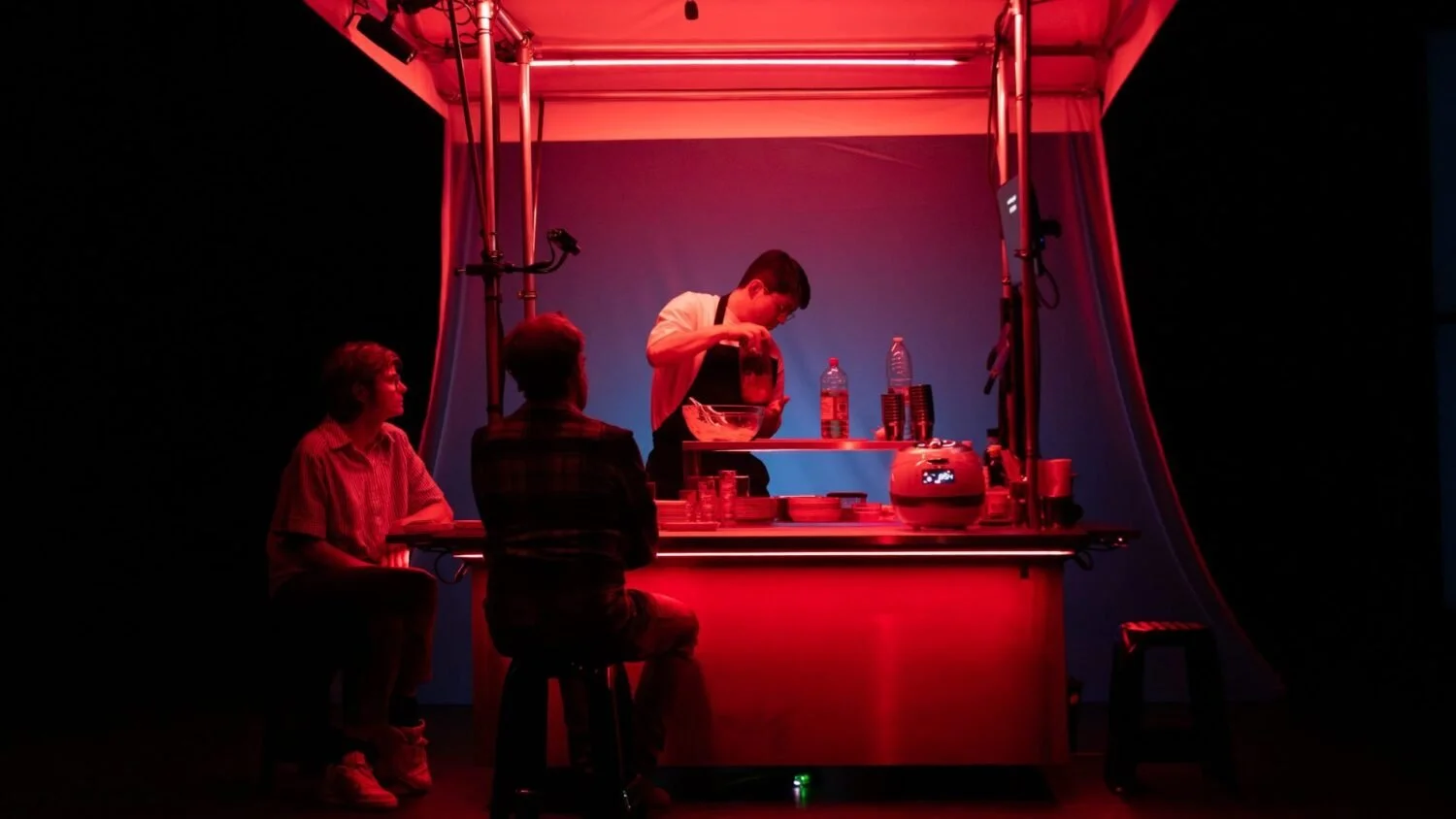
© Bea Borgers
Goya van den Berg writes about fermentation as a way of thinking beyond fixed boundaries between nature and culture. Using Jaha Koo’s Haribo Kimchi as a starting point, the text explores how kimchi becomes both material and metaphor for migration, memory, and otherness.
Unruly to its core, fermentation defies boundary-making and combat mentality. It blurs lines between nature and society and suggests that true security may lie in conscientious impurity, not coerced purity.
–Aaron Bobrow-Strain in White bread: social history of the store-bought loaf
It is your head they take.
Sturdy ribs fused at the base.
Leaves fold inward atop one another, like hands crossed together in prayer.
Pale varicose veins draw a delicate pattern across your soft green features.
One sharp motion severs it from the soil in which it has grown. A clean cut.
A small incision, then fingers digging in, prying two halves apart.
Again, a gash.
Rip.
You are surprised at the ease with which you come apart.
Lie there on the cold counter, quartered.
Quickly, your core is cut away from you. More leaves tearing around you. Little cracks ripple through the silence, uneven as if the sound too keeps getting snagged.
Working their way from the outside in, each leaf is individually sprinkled with salt. You are bedazzled with miniscule crystals. Tiny flakes glitter beneath the kitchen light. Then the jagged edges start irritating your skin. Cell walls burst with a thousand cuts. Coarse pieces rub between your folds. Carefully, fingers lift the flaps of your heart. The most tender part of you. Speckle it with shards.
You are placed in a bowl together. Pushed up against one another. Your tips can feel something which used to belong to you. Which you used to be. You think. You are unsure. In this new environment, it is hard to identify whether it is really a part of you which you sense or something like it. Only a dim light filters through the leaves above you. Grouped together, there is semblance around you. Now bent over and molded to fit in. Tucked together. Smothered. Then all at once, darkness. Some kind of weight is placed on top of you. Presses down. Far away, muffled sound of metal against resistance, then hitting wood. Chopping. Slowly, you sink into one another.
—
Flanked by two screens, a Korean street food stall stands in the middle of the stage. Several jars stand on the counter. Another empty seat on the other side. A bright red light beats down from above. I am seated in the audience when Jaha Koo extends the invitation to join him at the bar. He looks around the red seats facing him.
Would you like to have some food at the pojangmacha?
Two bodies emerge and take a seat at the bar. As I can sense in the people around me, a twinge of jealousy runs through me while they cross the fourth wall onto the stage. Koo pours the two customers a drink, offers them an appetizer. Cucumber with ssamjang. Casually, like one might hear a barman start to relay their history, he begins to talk about his experience of migration, all the while starting to prepare the first course: kimchi pancakes.
He opens one of the large preserving jars, grabs a bright red tangle with a pair of tongs. While he cooks, Koo describes leaving Korea for Berlin with a vacuum sealed bag of kimchi – 10 kg – that had been prepared by his grandmother. Koreans survive on rice and kimchi was the adage. The staple Korean fermented cabbage is placed in a glass bowl and as Koo adds flour and mixes thick red streaks colour the sides.
The story unfolds. In the taxi from the airport, he becomes aware of a pungent smell. Upon arrival, he finds that the bag with kimchi has blown up. The screens show a balloon filled with a fleshy substance. As if cued, it is at this moment that I become aware of the scent for the first time.
A deep odour fills the room. It seeps from the jar into the audience, crossing the fourth wall.
The scent is the result of fermentation, where bacteria that live in the soil in which cabbage grows start feeding on the sugars once the plant is taken from its roots. When controlled, by promoting the growth of some microbial cultures and limiting others, fermentation creates the circumstance in which substances are transformed into something which can be preserved for a long time. Kimchi, one such preserve, is the result of a lively process of microbial activities.
In her book, Denken met Microben (Thinking with Microbes), Kristien Hens (2025) offers microbes as a category of life which is invisible, plural, diverse and relevant. Departing from a belief in the entanglement of all the elements which make up our multiple global crises, Hens disentangles and rebraids ontology, epistemology and ethics in pursuit of staying with complexity and use confusion as fertile ground to think through large questions around scientific paradigms and philosophy. It is microbes, difficult to categorise, challenging human frameworks, which might open up the ways we conceive of boundaries and notions of symbiosis.
Almost as if calling for attention –smell me, I too play a part– the kimchi on stage reminds me of its presence. The story continues with a harrowing description of Koo’s panic at the sight of his kimchi bag. He places it on the balcony, where, under the power of the sun, it ends up exploding. When he arrives home from an outing the next day, he finds an angry neighbour at his door complaining to his housemate, describing a bloodlike substance leaking onto her patio, “a smell of dead cats.” When she realises he is also there, she becomes quiet. His othering –and shame– materialises specifically in the silence. The kind of racism which requires an awareness and perception that goes beyond listening to words, for the implications of the unspoken.
Koo serves his guests, then puts the leftovers onto a third plate which he places on the side opposite them, in front of the seat which seems to be left for all of us to share. He leaves the kimchi jar open. Another wave of the rich odour comes my way. While he prepares several courses (after the kimchi pancake follow cold seaweed soup, fried mushroom and a jelly dessert), Koo weaves together anecdotes from his life to tell a story of crossing cultures. Sounds of chopping and sizzling mix in with his voice.
Central to the way he explores a history of migration, is kimchi. It acts as a metaphor, tasting best when suffocated, cannibalising itself. It is an element of his stories –one starts when he is buying ingredients for kimchi, in another the smell politics associated with the ferment play a key role in his feeling of otherness upon arrival in a new place. He feeds it to his guests. Every once in a while a waft of the smell will find me and my eyes will go back to the bright red mass. Sometimes I imagine within it the bubbles forming, too joining the rich soundscape of storytelling. And I start wondering: What was the role of the kimchi in the tale? What does it mean to consider these wild cultures as part of the crossings that Jaha describes?
–
Jane Bennett (2009) calls for paying attention to the presence of nonhuman materials in our political world. Rather than seeing matter as something passive, acted on by (human) agents, she asks: what does it mean to take seriously the role of nonhuman actants in shaping events? Bennett actively pays more attention to the ways we are always bound up in multiplicity, and power outages, microbes and worms have real impact on what we conceive of as human activity. For this she draws on Guattari and Deleuze’s notion of assemblage, a temporary grouping of elements without centralised power that together make up a phenomenon: “The effects generated by an assemblage are, rather, emergent properties, emergent in that their ability to make something happen … is distinct from the sum of the vital force of each materiality considered alone.” Agency, for Bennett, is distributed across this kind of group, rather than being localised in a single (human) body. In a world of vibrant matter, it is thus not enough to say that we are “embodied.” We are, rather, an array of bodies, many different kinds of them in a nested set of microbiomes.
As he prepares his dishes, Koo leaves the jars open. What has been left in the space shall not be put away again. And so the demand on my understanding of who and what is acting in this story is not allowed to be put to rest. The persistent waves of smell act as a reminder of the nonhuman activity on stage. The more I think about the microbial cultures, the more I realise that I had treated the other nonhuman actors in his history as metaphors or props. It is only once I start thinking about the role of microbes in Koo’s story about his racist neighbour that I realise that nonhuman entanglements play throughout.
In fact, the very first anecdote is about a little snail –tenderly called Gona– who Koo finds on a piece of kimchi cabbage and cohabitates with for a while. Though the tale can be understood metaphorically –isolated at Koo’s house he displays symptoms of what might be termed homesickness, eventually resulting in a decision to place him back among his peers– there is a material aspect which should not be underestimated. Cohabiting with snails is what we do, and our personal and broader histories are shaped through these very concrete interactions.
Koo himself draws attention to this as he shares the origins of the chili used in kimchi preparation today. The spice, which gives the ferment its recognisable colour, only became a staple ingredient during the Little Ice Age when global temperatures dropped by three degrees. Koo describes how the fluctuation in temperatures disrupted harvests around the world, leading to devastating food scarcity. Widespread migration of humans seeking nourishment and escaping famine also resulted in a displacement of ingredients. In Korea, the change greatly impacted salt production. To make up for the lack of salt, a replacement was found: chili.
The microbial interaction which resulted in the blood-red kimchi juice trickling down his balcony onto the neighbour’s –and the racist encounter which accompanied the experience– was itself intertwined with a complex history of cultural migration. The intricate dance of humanity and nonhumanity, which, according to Bennett, has always existed, comes to the forefront.
If one had not seen the performance, it might now appear as if organic matter takes center stage. But taking seriously the matter of these nonhuman presences in the story attunes me to the way they are, too, materially present in the performance itself. Throughout the performance, the two screens continually show images associated with the stories: from scenes in Costco to the near-bursting bag of kimchi to seaweed flowing in the water. Their presence culminates when, during the preparation of his dessert, Gona the snail makes a return singing a song. Meanwhile, a mechanical eel slithers across the stage. What Haribo Kimchi allows us to think with is the nonhuman in the broadest sense.
And this is not only the animal which is rendered present through technology. Parts of the soundtrack have been created through the use of computer-generated voice. Koo has written the melodies and lyrics, then used a machine-voice to sing. More-than human entanglement shapes both the form and the content of the play.
Here, microbial cultures and technological interfaces come together. And thus I am faced with my own anthropocentrism. From Gona to the eel to the migration of ingredients, it is easy to think of these as metaphors. Taking them as both metaphor and material opens up the scope of Haribo Kimchi as a complex web of entanglements. Paying attention to the microbial dimension of Haribo Kimchi offers a way to think about the multiplicity of personal history, and the strands that might be revealed if we open the field of our perception.
–
At the end of the performance, the two eaters are asked to return to their seats. Koo, walking out from his stand, offers a few glasses of somaek –a mixture of beer and soju– to the audience. He comes into the seats and reaches over and across various people to deliver the drinks, crossing the porous boundary between audience and stage. Once more, Jaha Koo shows how permeability goes both ways. The natural and social, cabbage and microbe, Germany and Korea.
After the applause, the public is invited onto the stage to taste what has been prepared. Koo has gone backstage. A large bowl of seaweed soup, just a few plates of fried mushrooms and the jar of kimchi stand without instruction. Multiple bodies converge around the stand. The food has not been portioned out, the offering refutes the possibility to return to disentanglement. Instead, the allure of taste demands interaction and negotiation with one another.
Goya van den Berg (1998) is dramaturg en schrijver. Vertrekkend vanuit wetenschappelijk onderzoek naar verschillende zintuiglijke ervaringen, vervaagt ze graag de grenzen tussen het menselijke en niet-menselijke. Haar academische werk The Scents of an Ending: (Dis)Entangling Climate Change Narratives and Archival Processes in Olfactory Art verscheen bij Tectum Verlag.