IDFA — Below the Clouds: A Timeless Gaze on the Campi Flegrei
Documentary ★★★★☆
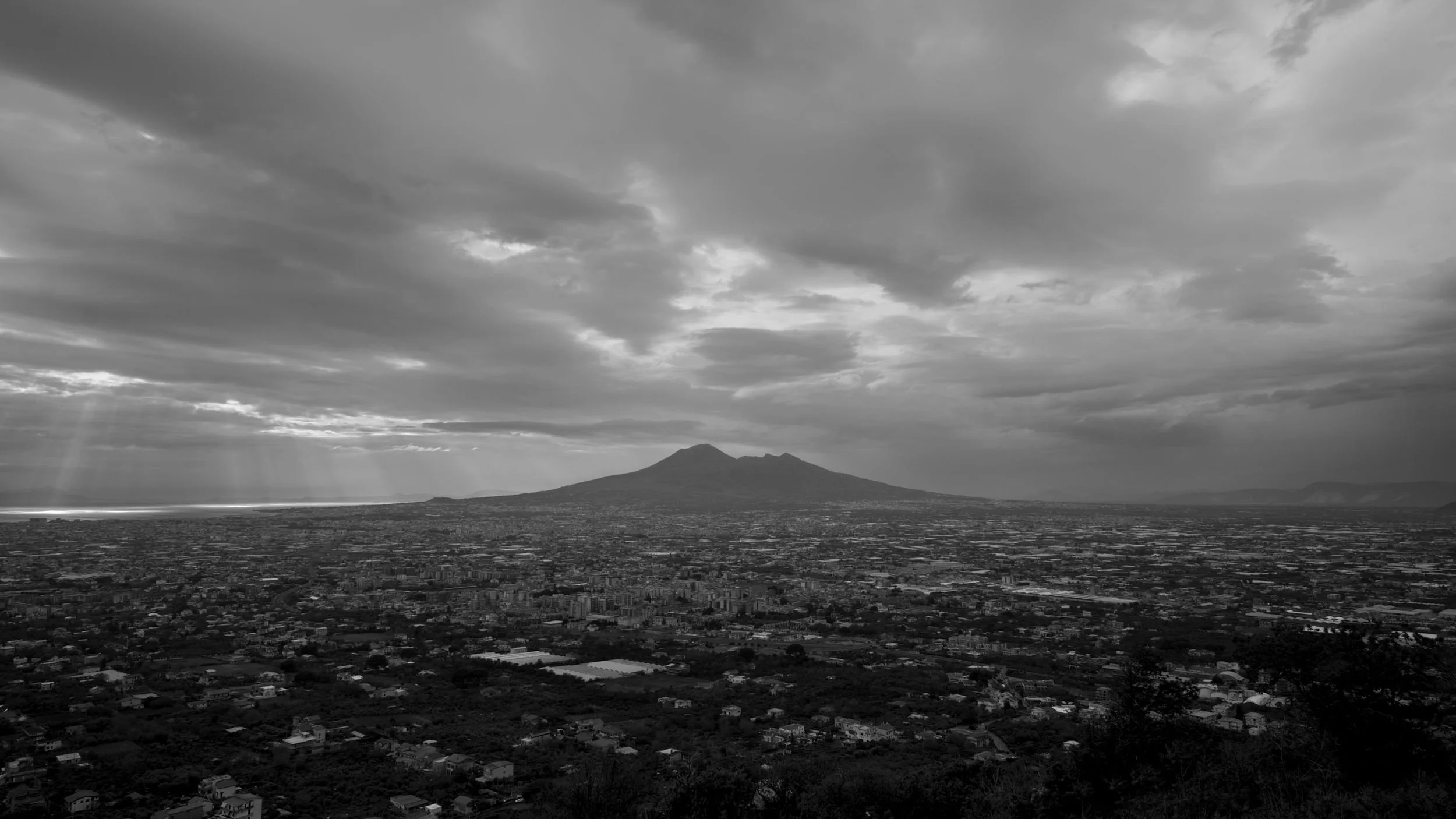
© Image courtesy of IDFA / Below the Clouds
Liliana Gaddi watched Gianfranco Rosi’s latest documentary, Below the Clouds, during IDFA. Through black-and-white imagery and a series of intimate, parallel stories, Rosi paints a quietly compelling portrait of the Campi Flegrei, where everyday life, history, and the wider world intersect.
There is something poetic, and perhaps also frightening, about the black and white imagery of Below the Clouds, Gianfranco Rosi’s new documentary. This latest project by the Italian-American filmmaker has been awarded the Special Jury prize at the 82nd Venice International Film Festival and recently presented at IDFA. For viewers unfamiliar with the landscapes of the Campi Flegrei, in the close proximity of Naples, these territories slowly start to gain a distinctive identity through the people and places Rosi allows us to encounter.
Portraits of a territory
As the film begins, we immediately dive into the world of the many people that make up its different parallel storylines. We are introduced to them while they are absorbed by their daily life activities and it is up to our imagination to figure out what might be connecting them to each other.
“She wanders among Roman statues and archaeological remains with the care one usually devotes to children, talking to herself while praising the beauty of the statues.”
We meet Maria, who is completely immersed in the task of cataloguing the underground depot of a museum. She wanders among Roman statues and archaeological remains with the care one usually devotes to children, talking to herself while praising the beauty of the statues. She does so in a way so fascinating that one wonders if she’s aware of the outside world at all, or just unbothered by it.
An old man, “Titti”, holds space for local youth in the back of his antique store and helps them with their homework every afternoon. As we see him interact with the kids, it seems impossible to think that he hasn’t always been there, there couldn’t possibly ever have been a time in history when kids couldn’t spend the afternoon asking him questions about maths, french, english and literature while he spent time reading Les Misérables by Victor Hugo, and finishing it in a week.
A team of firefighters working in their emergency call centre becomes the one constant of the documentary, the one regular rhythm to this composition. It is their calls that make us reflect on what irony truly is: “Is this tragicomedy or simply life itself?” we wonder, as we listen to their patient, and sometimes funny, conversations throughout the film. Through their perspective, we learn about people calling to report domestic abuse, a kid making a phone prank, a man calling every day to ask for the time, or people needing reassurance regarding frequent earthquakes and gang violence.
Then there are the Japanese archaeologists who have been in charge of an excavation site in Pompeii for over 20 years, as well as local institutions developing strategies to go after tomb robbers, tombaroli, while sighing at the realisation that parts of their identity may be forever lost.
The interconnected everyday
Lastly, there is Rosi’s choice to include the storyline of Ukrainian grain, filming close ups that make it look like mountains, creating a parallel with the shapes of the Vesuvius. The grain takes days to be unloaded from one of the cargo ships that just arrived from Odessa, where the war has turned them into a target.
Filming the process of unloading the grain, while focusing on the life of the Syrian workers on the boat, adds an element of social critique and awareness: Naples and the Campi Flegrei are not a timeless bubble after all, one might be eating a pizza overlooking roman ruins, but that pizza might be made with Ukrainian flour, unloaded at the harbour by Syrian workers. In this way, a connection is made between the local experiences we have seen so far and the wider world.
It is precisely the international element that makes Rosi’s portrait of the Campi Flegrei a non-stereotyped one. The cargo ship from Ukraine, the Syrian workers and the Japanese archaeologists all open up the possibility of alternative life experiences, at less of a distance that one would intuitively say.
A composition instead of a narrative
Rather than a single storyline, the structure of the documentary unfolds like a composition: different portraits, corresponding to different storylines, creating one bigger portrait, the fragile equilibrium of their interplay. Even if none of the storylines literally cross, there is something more than just location uniting them.
“In that climate of general anxiety and black and white melancholy, life moves on, with a good amount of laughter as well.”
As the director Rosi describes in an interview at the New York film festival (NYFF), the way he found continuity amongst the many narratives was by realising that, in their own way, all are giving something to others. This relationship established by giving goes beyond human bonds and time. It’s a collective creation of a bond to a land with both historical richness and geological insecurity. In that climate of general anxiety and black and white melancholy, life moves on, with a good amount of laughter as well.
Every person becomes a window into a different world. Criticisers might say that they remain only that – windows, perhaps too briefly opened. Is it a superficial approach? Does the aesthetic dominate the message here? It is certainly understandable for one to remain disappointed by the lack of information we have about any singular story by the end of the film. Afterall, we do see everyone engaging in just one of the many activities of their lives. However, it is precisely the simultaneousness of their activities, together with those of all who are not featured in the film, that collectively shape the identity of the Campi Flegrei.
The choice for black and white
One might question the decision to shoot entirely in black and white as well. At first it might seem excessive, but as the film progresses, an element of timelessness starts to dawn upon us, we feel the distance from the subjects in a way that it feels we are looking at the past, but it is in fact the present we are observing. This is precisely what Rosi meant to achieve: to capture the idea that, as one films, the present becomes the past, creating a visual archive of contemporary life.
Looking at the film through this lens, it becomes evident that this is exactly what it is. Every storyline is a window into the world of the Campi Flegrei, a moving picture, showing us a piece of life of those who have been there forever or are just passing by, but nothing more than that, all tied by an invisible chain of interconnected deeds. It only makes sense that colour, which has disappeared from the roman statues we see, also dissolves here to highlight the centrality of these actions.
With a special mention to Daniel Blumberg, winner of the Academy Award for best score with The Brutalist (2024), who complemented the poetry of the visual imagery with a perfect musical score, and to the thoughtful editing of the film, Below the Clouds certainly deserves attention. Rosi managed to take the colours out of the often romanticised area around Naples, revealing something more beautifully complex lying beneath the surface.
To watch Below the Clouds is like looking at a painting. You stand still in front of it until the frame gets blurred and the details start to carry you to a different reality. It’s not meant to entertain, but to guide the viewer in a quiet journey through a land so full of contrast and so often hard to grasp.
Liliana Gaddi studies Peace, Trauma and Religion. She combines her passion for visual art and storytelling with a commitment to social justice.