IFFR — Annemarie Jacir’s Palestine 36 Turns History Into Urgent Cinema
Film ★★★★☆
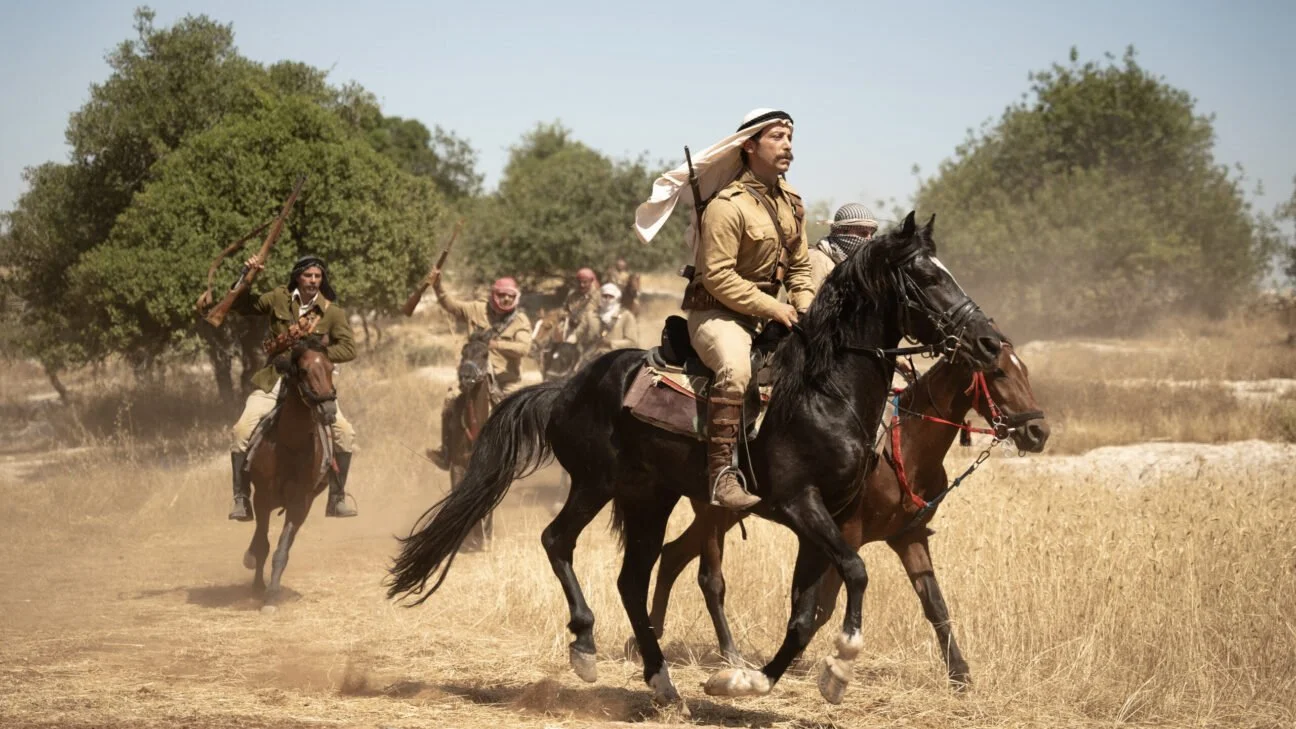
© Palestine 36, film still.
In Palestine 36, Palestinian filmmaker Annemarie Jacir turns to history to confront the present. Stefanie Gordin reflects on the film’s urgency, its engagement with memory, and the political reality it cannot be separated from.
During the International Film Festival Rotterdam (IFFR), I was working on this article when a woman approached me and said, “There is no apartheid in Israel.” She was referring to an Amnesty International sticker on my laptop. Before I had time to process what she had said, she walked away. There was no space to respond. I was left with a knot in my stomach. Not only from disagreement, but from the ease with which the statement was delivered.
It felt no coincidence that only a few hours earlier I had attended the screening of Palestine 36. If there is a film that unmistakably resonates with the present moment, it is this one. By turning to the past, the film exposes how the historical conditions of Palestine continue to shape the present — in structural violence, in displacement, and the ongoing genocide in Gaza.
Directed by Palestinian filmmaker Annemarie Jacir, Palestine 36 is set during the Arab Revolt against British colonial rule in Mandatory Palestine between 1936 and 1939. Through multiple characters, the film unfolds as a layered narrative of resistance, loss, and perseverance. Colonial power is not presented as an abstract system, but as something that infiltrates daily life, shaping relationships, movement, and survival. The film offers historical insight while refusing emotional distance; it lingers long after the credits roll.
Colonial power and everyday life
The narrative situates the British government’s post–First World War commitment to establishing a Jewish national home in Palestine as a decisive turning point. This becomes evident, among other things, in the allocation of the vast majority of governmental concessions to Zionist institutions. As Palestinian communities respond through strikes, boycotts, and acts of sabotage, including attacks on railways and government infrastructure, their resistance appears both urgent and tragically insufficient in the face of imperial power.
At the centre of Palestine 36 is Yusuf, a young man from the fictional village of al-Basma, played by Qalqilya-born actor Karim Anaya. The village has become a target of British colonial forces seeking to suppress the rebellion that has been simmering after two decades of rule. Yusuf, a driver by profession, is gradually drawn into the resistance, navigating both political complexity and personal consequence.
The film unfolds through multiple perspectives, with women taking a central place in its narrative fabric. One such figure is Khuloud Atef, a journalist forced to publish under a male name in order to be taken seriously. Another is Hanan, portrayed by Hiam Abbass, a familiar presence in Palestinian cinema. In one scene, Hanan speaks to her granddaughter Afra about the people’s connection to the land, foregrounding oral history as a vital carrier of Palestinian collective memory.
Children, too, play a crucial role in the film’s vision of continuity. Despite witnessing dispossession, imprisonment, and the killing of family members, they are shown as the inheritors of resistance, carrying forward a struggle shaped by loss, but sustained through remembrance and attachment to place.
Jacir interweaves fiction with historical archival material drawn from British sources, which she deliberately color-graded. Rather than aestheticizing the past, the choice collapses temporal distance, preventing history from retreating into black-and-white abstraction. The past is not framed as concluded, but as something that remains active and unresolved.
The film unfolds with a sense of scale, evident in its carefully chosen costumes, meticulously designed sets, and restrained color grading. The soundtrack supports the narrative without overwhelming it, drawing the viewer into the intertwined lives of its characters. It comes as no surprise that many viewers leave the cinema in tears: the reality the film evokes, and the injustice it exposes, sit uncomfortably close to the images that continue to shape our present.
Cinema under pressure
The production history of Palestine 36 bears the marks of the reality in which it was made. Filming was originally scheduled for the second week of October 2023, but was halted entirely after October 7, actress Hiam Abbass explained during the post-screening discussion. Eventually, parts of the production were relocated to Jordan, where the entire village of al-Basma was reconstructed and landscapes resembling Palestine were carefully scouted. Only later were a limited number of scenes filmed in Jerusalem.
Abbass also recounted that during an earlier screening in Jerusalem, Israeli police entered the cinema and confiscated the projector. As she spoke, her voice faltered. For safety reasons, the director and her team were unable to attend IFFR. The incident underscored how Palestine 36 cannot be separated from the political reality in which it circulates.
During the post-screening discussion, an audience member asked whether Palestinian cinema can have any tangible impact on the ongoing dispossession of land and the violence unfolding in Gaza. Abbass pointed out that three films about Palestine are currently part of the 2026 Oscar selections — Palestine 36 (Palestine), All That's Left of You (Jordan), and The Voice of Hind Rajab (Tunisia) — a development that signals, however cautiously, a broader shift in visibility.
As she concluded, land for Palestinians is not an abstract concept. It is where ancestors lived, where food is grown, where people are raised and grow old. It is not something that can be surrendered without consequence. For that reason, the struggle continues. Palestine 36 is a film that demands to be seen, and, more importantly, to be engaged with, discussed, and remembered.
Stefanie Gordin is a writer, journalist, and co-founder of Rephrase Magazine.
