Stolen Futures: From Iran’s Unfinished Revolution to Today’s Protests
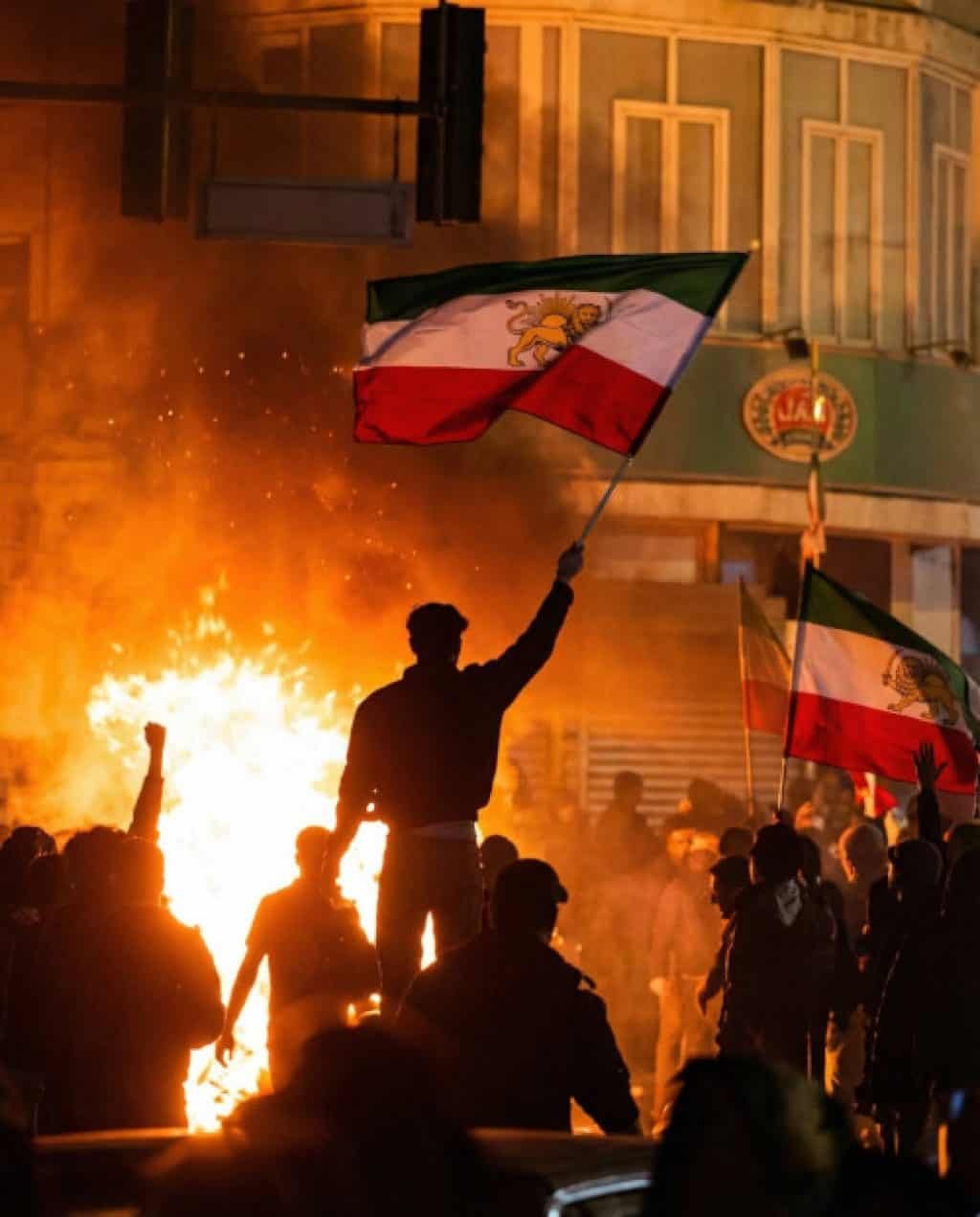
© Iran, protests 2026. Photographer unknown / Source: Internet
As protests once again erupt across Iran, history feels uncomfortably close. In this essay, Aiden Bijloo traces the parallels between today’s unrest and the unfinished revolution of 1979, weaving political analysis together with his family’s lived experience across generations.
Once again, Iranians are taking to the streets. What began in late 2025 as protests against soaring inflation and economic hardship quickly spread across the country, evolving into a broader demand for freedom from a system that regulates daily life and denies people a voice in their own future. Iran is a complex and often misunderstood country, shaped by a long history of repression and resistance. Yet one reality has become unmistakable: Iranians refuse to be defined by their fundamentalist, autocratic rulers.
For my family, this moment does not feel new. My mother was barely in her teens when Iran last experienced such a mass upheaval. When the Iranian Revolution of 1979 unfolded, what she remembers most was not celebration, but chaos and uncertainty. No one knew who would prevail or what kind of country would emerge, but many believed that whatever followed could not be worse.
To understand the current protests, it is necessary to look back to that earlier moment. By drawing parallels with the protests of 1979 that led to the establishment of the Islamic Republic of Iran, it becomes possible to see what has changed, what has been lost, and why the struggle for freedom endures.
An unfinished revolution
In 1979 the King of Iran went on a “vacation,” at least that is how the official news channels presented it. After months of protests and years of growing civil unrest, Shah Reza Pahlavi, Iran’s US-backed monarch who had ruled the country for more than three decades, fled the country. The language of departure softened what was, in reality, the collapse of the state’s authority.
The regime of the Shah, the Persian word for king, was seen as oppressive and brutal by many people in Iran. Although it brought economic prosperity, his modernisation agenda expanded education, infrastructure, and women’s legal rights, while pushing land reform and urbanisation at unprecedented speed. Yet these reforms were imposed from above, with little public participation or political accountability. Traditional power structures were dismantled without being replaced by democratic institutions, opposition parties were sidelined, and dissent was crushed.
In daily life under the Shah repression was real, but some freedoms were also guaranteed by his rule. There was no freedom to organise politically or openly criticise the state. Yet there was the freedom to kiss your partner in public, to attend parties, and to move through public spaces as a woman without wearing a hijab. In everyday life, people could express themselves, even if politics remained closed.
This ambiguity explains why my family initially supported the Shah, despite his authoritarian rule. My grandmother still remembered a time when religion dominated Iranian politics, and she feared what its return might mean. When the neighbours shouted from their windows “Down with the Shah!” she closed the windows without hesitation.
“As my mother later reflected, the revolution was not won by those with the broadest support, but by those who were the most organised.”
Many who protested the Shah did not do so to replace one autocracy with another. Communists, socialists, liberals, conservatives, and moderates all participated. Few imagined that Iran would become a theocratic state, meaning a state where religious leaders hold all the power. Yet, as my mother later reflected, the revolution was not won by those with the broadest support, but by those who were the most organised.
A key figure to emerge from the revolutionary turmoil was Ayatollah Khomeini, an exiled cleric who became a unifying symbol of opposition to the Shah. Speaking from abroad, he appealed to a broad range of Iranians by framing the revolution in moral and anti-imperialist terms and promising justice, dignity, and popular sovereignty. In the chaotic months before the Shah’s departure, many moderate and secular actors initially supported him, not because they shared his ideological vision, but because they saw him as the most organised force capable of preventing disorder. By the time it became clear that Khomeini’s project rested on strict religious rule, the marginalisation of women, and the suppression of political pluralism, power had already consolidated around his faction, leaving little room for alternative futures.
After the Shah’s departure, Ayatollah Khomeini and the militant Islamist faction around him consolidated power with remarkable speed. Promises of democratic freedom were quickly abandoned. Restrictions followed soon after, such as the mandatory wearing of the hijab in public spaces. This was also when my mother took to the streets, on March 8 1979, International Women’s Day, women across Iran protested against the new Islamist restrictions, including the introduction of mandatory hijab laws. Women from all walks of life marched together, fearing that the civil rights they gained under the rule of the Shah would be stripped away. Initially, the new authorities appeared to retreat.
That hesitation did not last long. When Iraq invaded Iran in 1980, it triggered an eight-year war that claimed more than a million lives. The newly established Iranian regime used the conflict to consolidate its hold on power, strengthen the military, and suppress political opposition.
Women, memory, and resistance
The protests that erupted across Iran in 2022, in response to the death of Mahsa Amini, a 22-year-old woman detained by the morality police for allegedly wearing her hijab “incorrectly,” were not an isolated flare-up. They became a nationwide movement demanding nothing less than basic autonomy and freedom and a powerful expression of long-standing resentment toward a system that intrudes into the most personal aspects of daily life, from strict clothing rules for women and the suppression of free speech to far-reaching restrictions on women’s rights in marriage, divorce, employment, and access to political office.
Once again, women were at the forefront of the protests, just as they had been in 1979. The movement, known globally by its slogan “Women, Life, Freedom,” was remarkable not only for its scale but for its meaning. Iranian women were not simply protesting a dress code, but they were rejecting a regime that insists on controlling their bodies, relationships, and futures. Women and men from different backgrounds united and took to the streets, chanting against theocratic rule and calling explicitly for the overthrow of the Islamic Republic itself.
“It is almost like before, when young people walked the streets and had fun, without fear of prosecution. It is almost like before the revolution”.
By the end of 2023 the protests had been met with brutal repression and the immediate uprising had subsided, but the memory of resistance did not disappear. Everyday acts of defiance persisted. Women appeared unveiled in public and young people pushed cultural boundaries. As my grandfather, who lives in Tehran, told me: “It is almost like before, when young people walked the streets and had fun, without fear of prosecution. It is almost like before the revolution”.
Yet the people of Iran can not simply wait and hope that the regime will gradually change and become more moderate. That is why in late 2025 a new wave of protests emerged across the country, initially sparked by economic collapse and soaring inflation. What began as street demonstrations by shopkeepers and bazaar merchants in Tehran quickly escalated into widespread unrest, spreading to cities like Isfahan, Mashhad and Shiraz.
“Then on January 8, everything went dark. Internet and phone access across Iran was shut down.”
Once again, the people of Iran appeared to unite, with women and youth at the forefront, linking economic despair to long-standing political repression. Social media was flooded with images of mass protests and calls for political change. Then on January 8, everything went dark. Internet and phone access across Iran was shut down, cutting the country off from the outside world and silencing those trying to make their voices heard.
Only gradually has contact with people inside Iran become possible again, and the messages that are emerging are bleak. In an effort to restore internet access, some have turned to Starlink, which despite being illegal to own, has been widely smuggled into the country. As it stands, thousands are believed to have been killed during the protests, many more wounded, and, according to the most recent estimates, at least 3,000 people have been arrested.
Still, even after being beaten down by the Iranian regime, now being ruled by Ayatollah Khamenei, the people call for change. What unites the Iranians is a shared conviction that the current system must end. For many, the demand has become simple: the Ayatollah must go. Anything is better than the current religiously motivated dictatorship headed by the Ayatollah. Some protesters and diaspora voices call for Reza Pahlavi, the exiled crown prince living in the United States, to step up and lead the Iranian opposition. Others call for the United States to intervene and even urge them to forcibly remove Iran’s leadership, drawing on examples of foreign interventions elsewhere.
Given Iran’s history of international interventions, it is difficult to see how outside force could improve the situation. These appeals must therefore not be seen as a faith in foreign saviours than they are about exhaustion with a system that appears immovable from within.
Despite the diversity of slogans and visions for the future, one theme unites Iranians on the streets: freedom. Freedom to choose how to live, freedom from an ideology that regulates every corner of life, and freedom to decide Iran’s future on Iran’s own terms. And yet, once again, as in 1979, whether the regime will fall and what would follow, remains uncertain. No clear political programme has emerged from the streets, nor has a definitive leadership crystallised.
What has happened, however, is profound. Across generations, cities, and social divides, Iranians have articulated a shared yearning for self-determination. In a country as beautiful, diverse, and ancient as Iran, that yearning may yet become the seed from which lasting freedom can finally take root, if only its people are allowed to decide their own fate.
Between hope and uncertainty
Speaking with my family about the protests has become difficult, not only because of the uncertainty, but because contact with people inside Iran remains fragile. Much of my Iranian family left the country years ago, but amongst others my grandfather and two cousins are still there. When my cousins in Tehran managed to call, they told us that they and my grandfather were safe. Beyond that, they said little.
The conversation was brief and cautious, emptied of detail, and they did not speak about the days when we had lost contact. Later, a family friend called and said simply that the situation was horrible, many people had been killed and everyone lives in fear about what comes next.
Together with my mother, I joined protests in The Hague against the Iranian regime. These demonstrations offer a space to meet others who carry the same fears for their families and for Iran’s future. Hope remains amongst everyone that this time the protests might lead to real change. When my mother and I speak about the future, we are honest with each other: we do not know what will come. We can only hope that Iranians will finally be free to shape their own lives, without fear of repression.
Aiden Bijloo has an academic background in international humanitarian action and has worked with humanitarian organisations in Thailand as well as at NATO. With family roots in Iran, he has a long-standing interest in developments in the country. He currently works at the Netherlands Enterprise and Development Agency as a Programme Advisor for Humanitarian Affairs and is active with the Dutch National Youth Council (NJR), contributing to the representation of youth voices in governmental policy.