COLUMN / The Invisible Bureaucracy of Killing in NAZA
In her bi-weekly film column, Liza Kolomiiets follows the films that stay with her, using them as starting points to explore cinema and the world around us. This time, she watches Yuval Abraham and Rachel Szor’s NAZA (2026), a documentary about the Israeli military and intelligence systems used in Gaza that leaves much of its horror to the viewer’s imagination, while attracting fierce criticism from people who have never seen it.
I had already seen plenty of people talking about NAZA before I watched it. Some said they would never see it, others called it propaganda without having watched it, and many seemed to have decided what the film was before it even reached a cinema. After finally sitting through it, I found myself thinking about how strange that is. NAZA is a painful film to watch, sometimes almost unbearably so, but much of its power stems from what it leaves to the audience's imagination.
Directed by Yuval Abraham and Rachel Szor and produced by Jonathan Glazer, NAZA consists largely of conversations with 24 Israeli military and intelligence insiders. Their faces are hidden in darkness and their voices digitally altered, while they describe systems used to surveil Palestinians and select targets in Gaza. The film was produced in collaboration with The Guardian, building on investigations that Abraham and others had previously published. The filmmakers have said that they spoke to many more sources during their research, while the 24 people appearing in the film agreed to anonymity because of the risks involved.
“There are no familiar documentary close-ups, no faces to read for guilt, shame or fear. Instead, we get voices. Some speak with discomfort. Others sound almost proud of their expertise.”
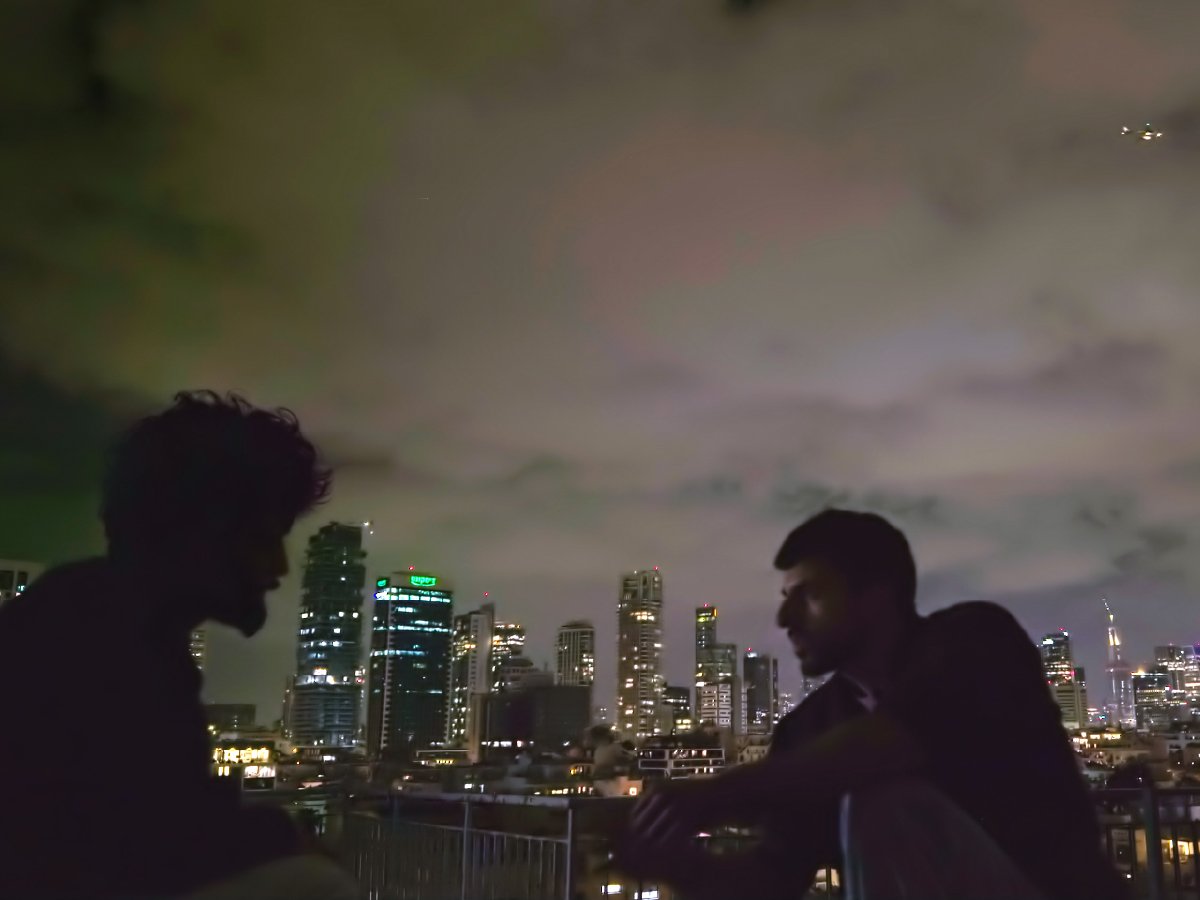
The decision to hide everyone is immediately unsettling. We see blurred heads against the Tel Aviv skyline, but we cannot properly see who is speaking. There are no familiar documentary close-ups, no faces to read for guilt, shame or fear. Instead, we get voices. Some speak with discomfort. Others sound almost proud of their expertise. Several describe their work in the present tense, leaving open the possibility that they might still be involved.
There is a distance between the people speaking and what they are describing. An interviewee explains an AI system called ‘Lavender’, which was used to identify potential targets from enormous amounts of data. Another describes ‘Where’s Daddy?’, a system that could use phone communications to determine when a targeted man had returned home. The most disturbing part is often the language used to describe these processes. A person becomes a target. A family becomes collateral damage. Expected civilian deaths become a number. Genocide becomes a ‘technical task’.
The film’s title itself comes from this vocabulary. ‘NAZA’ is an intelligence term used to indicate the expected number of civilian casualties from an attack. One interviewee describes 500 civilians being accepted for a single Hamas target. The IDF has disputed the claim, saying it has never planned, approved or conducted a strike in which anything close to that number of civilian deaths was anticipated.
At one point, the film cuts to archival footage of a much younger Benjamin Netanyahu defining terrorism as the deliberate and systematic killing or maiming of civilians for political purposes. Coming after the clinical descriptions of targeting systems, his words acquire a different weight. The film does not have to tell us what to think about the definition. It simply places it beside the language we have just heard, where civilian deaths have become an expected part of a technical calculation. The juxtaposition is almost too neat, but it works.
It would be easy for a film like this to overwhelm the viewer with images of destruction. NAZA largely refuses to do that. Instead, it stays in Tel Aviv. Uncomfortably, voyeuristically close, we see apartment buildings, streets, construction sites and people going about ordinary lives. The city is bright, busy and almost aggressively mundane. Against it, the interviewees calmly describe surveillance, bombing and death.
This is where the film becomes more than a journalistic investigation. Abraham and Szor understand that testimony can become more disturbing when the images are withheld. One man draws a simple pencil sketch of an apartment building whose residents are about to be hit by a bomb. Another recalls hearing a baby crying through a wiretapped phone just before he sent a drone towards the building. We never see either scene, yet both become very vivid in the imagination.
Quiet voices are interrupted by distant sirens, stretches of silence and an occasional high-pitched ringing that resembles tinnitus. At times, the ordinary sounds of Tel Aviv seem to belong to a completely different world from the one being described by the people on screen.
That is also where the film becomes difficult. I found NAZA genuinely painful to watch precisely because I had to imagine so much of what was being described. The long pauses in the cold descriptions leave space for the words to echo in your mind. The film gradually builds an atmosphere in which the ordinary sounds of Tel Aviv feel increasingly disconnected from what is happening only a short distance away.
Much of the discussion around NAZA has focused on whether anonymous testimony can be trusted. That is a legitimate question, and the film does not give us the kind of conventional journalistic verification that would resolve every allegation on screen. Critics have pointed to this as a weakness, while the filmmakers and The Guardian have defended their reporting and described a broader verification process behind the film.
“We have to listen to the words, look at the evidence the film does give us and decide what we make of it. As a piece of journalism, that uncertainty matters. As a piece of cinema, it becomes part of the experience.”
But anonymity also becomes part of the film's visual language. We are not given the reassuring feeling of knowing exactly who is speaking. We have to listen to the words, look at the evidence the film does give us and decide what we make of it. As a piece of journalism, that uncertainty matters. As a piece of cinema, it becomes part of the experience.
Near the end, the film finally leaves Tel Aviv. After almost 80 minutes of blurred faces and imagined scenes, we are confronted with the aftermath of an attack. The distance suddenly collapses. There are people searching through rubble, surrounded by bodies and the sounds of grief. It feels like a finishing punctuation mark to a film that has spent most of its running time refusing to show us exactly what we are hearing about.
When the credits rolled at my screening, the room was completely silent. Nobody said a word even as people began leaving. That silence stayed with me more than most of the arguments I had read about the film beforehand. After all the debates surrounding the film, after all the questions about who says what and what can be verified, there was nothing left to discuss at that moment.
You do not have to accept every claim in NAZA without questioning it. You can question its sources, its framing and its omissions. The ‘tell don’t show’ approach might not fully work for you. But if you are going to have an opinion about the film, you should probably watch it first.
NAZA will be screened in independent (Cineville-eligible) cinemas around the Netherlands and Belgium throughout October 2026 (except October 6,7, and 8 due to the filmmakers’ own request).
Liza Kolomiiets is a Ukrainian researcher and critic based in the Netherlands, working across film, fine art, and media. Her work focuses on themes of displacement and exile, while her curiosity extends to a wide range of visual forms and artistic expressions.