IFFR — Slowness, Inheritance, and Womanhood in Mascha Schilinski’s Sound of Falling
Film ★★★★☆
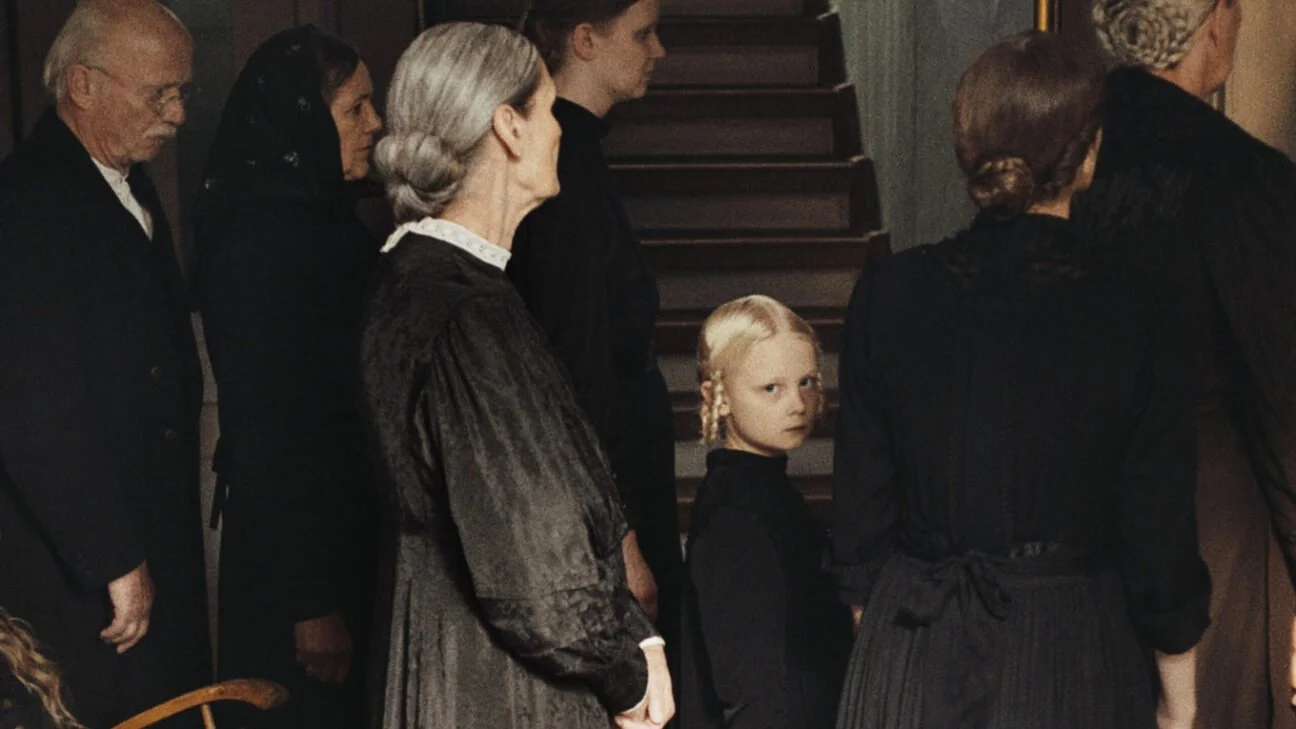
© Sound of Falling, film still.
Watching Sound of Falling at IFFR, Stefanie Gordin reflects on intergenerational memory, slowness, and the ways womanhood is shaped, repeated, and carried across time. Moving between film analysis and personal recollection, this essay lingers in the space where images, sounds, and emotions refuse to resolve.
If intergenerational traumas, emotions, and memories are indeed passed on in subtle, almost imperceptible ways, from grandparents to grandchildren, Sound of Falling (2025) gives that idea an unusually lucid form. The film follows four generations of women living on the same farmhouse in twentieth-century Germany, unfolding as an intimate, enigmatic, and at times grim portrait of womanhood across time.
In her second feature film, awarded the Jury Prize at the Cannes Film Festival, German director Mascha Schilinski rejects linear storytelling, moving freely through decades and lives. One moment we follow Alma, a young girl peering through keyholes; then Angelika, a teenager in the 1980s, roaming the surrounding fields without shame; then Erika, who harbors a forbidden desire for her cousin with an amputated leg; and Lenka, a contemporary teenager who longs to look up to someone else, to become someone else altogether.
“Moments surface and disappear without warning, like thoughts that arrive unannounced and only later acquire meaning.”
These lives do not unfold sequentially but continually interrupt one another, shifting back and forth in a constant exchange rather than forming a linear progression. Moments surface and disappear without warning, like thoughts that arrive unannounced and only later acquire meaning. The non-linear editing works associatively: scenes from different generations brush up against one another, mirror one another, and begin to resonate.
At a time when images and emotions move at increasing speed, Sound of Falling offers a rare deceleration — an invitation to observe, to repeat, and to linger with the deepest, often unarticulated layers of womanhood. Across its 150-minute runtime, the film exposes forms of oppression that continue to shape women across eras. From systemic inequality and dependence to physical and psychological violence; from self-erasure to sexualization, from abuse to suicide. Each experience is embedded in its historical context, yet the patterns remain disturbingly familiar.
Cinematographer Fabian Gamper’s camera drifts between intimacy and distance. At times the image is clearly anchored in a character’s point of view; at others, it seems unmoored, observing from an invisible presence — as if memories themselves have briefly taken on a body. Through cracks, floorboards, and keyholes, the camera searches for what it means to live, and to have lived. The grainy images often blur, hovering between daydream and reality, between escape and return. They evoke moments that resist definition: experiences that linger precisely because they cannot be explained, forming a shared, human recognition.
Sound, too, is indispensable. Anna Kühlein’s score and Claudio Demel’s sound design give the film a hypnotic, layered texture. Sounds appear to seep into the walls of the farmhouse, as if the place itself were a vessel for memory. Lives come and go, but traces remain. Stranger by Anna von Hausswolff returns in a magical-realist manner across generations, a motif that settles into the viewer’s body. After the film ends, the urge is to play the song on repeat, reaching back toward a moment that briefly felt eternal.
“Certain images linger, not for their shock value, but because they touch something that resists language: a desire for sexuality, for the unknown, for the uncertainty of how life might unfold.”
Schilinski’s vision of femininity is steeped in darkness, yet ultimately cathartic. Certain images linger, not for their shock value, but because they touch something that resists language: a desire for sexuality, for the unknown, for the uncertainty of how life might unfold. Each woman carries something singular, a detail that occasionally resurfaces in others — a genetic relay of womanhood and all that comes with it.
As a child, I remember thoughts hovering between life and death. I would swim underwater, hold my breath, searching for the edge — close enough to feel it, never to cross it. There was no wish to disappear, only a quiet curiosity about where the boundary lay. Sound of Falling seems to exist precisely in that in-between space.
Stefanie Gordin is a writer, journalist, and co-founder of Rephrase Magazine.
