The end of the world will be ours
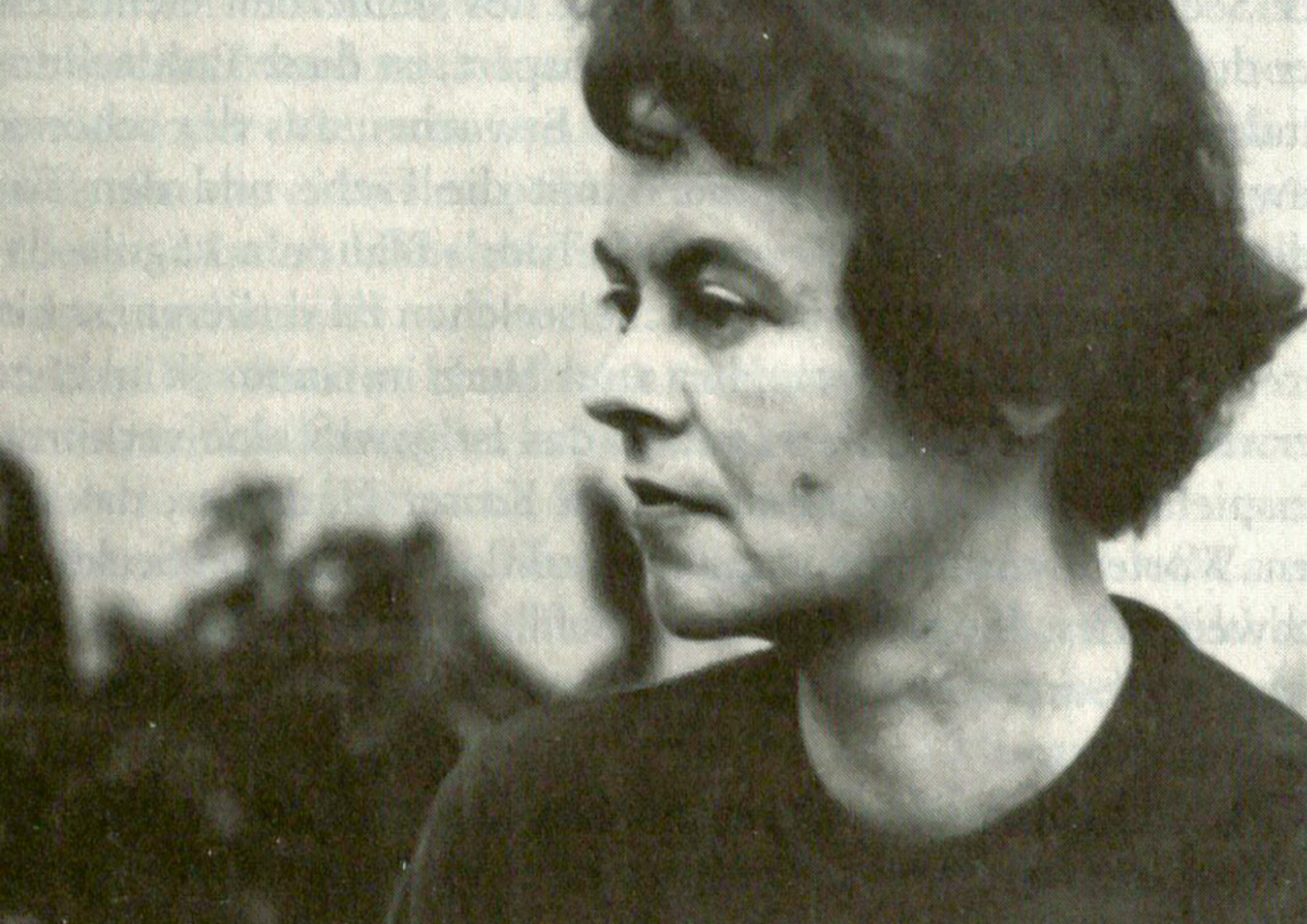
© Sybille Haushofer Steyr/Wien
Silvia Almeida writes about Marlen Haushofer’s The Wall, exploring how isolation becomes a space of both fear and freedom. She connects the novel’s vision of a woman living beyond society to ongoing struggles with gender, autonomy, and safety today.
Austrian author Marlen Haushofer was right about fictionalizing a woman secluded from the rest of the world. In her book The Wall, originally published in 1963, she depicts the life of a woman who suddenly finds herself separated from the rest of the world by an invisible wall; she records her years living among her animals and the forest. Everyone and everything on the other side of the wall, the unnamed protagonist finds is dead. Besides the immense claustrophobia you may feel reverberating from such a reality, if you read her novel closely, you can sense a forming peace rumbling in each sentence as the narrator describes living by her own rules, finally free from the constraints of her gender.
“Her isolated, apocalyptic life seems to be a more honest reality to her.”
The narrator hardly mentions her husband and when she does speak of her two children, she remembers them as “rather unpleasant, loveless and argumentative semi-adults”. Her isolated, apocalyptic life seems to be a more honest reality to her. As a stay-at-home housewife, Haushofer could only have experienced this kind of freedom in her fiction. Her work never received the attention it deserved in her lifetime, until the International Women’s Movement made its way to Austria and sales started rising as women viewed The Wall as a portrayal of a woman’s role in a male-centered society.
In the afterword, Claire-Louise Bennett, author of Pond – a collection of short stories narrated by an unnamed woman living on the edge of a small coastal town – writes:
The only way a woman can experience solitude, without judgment and recrimination scuffing up against her peace, is if the rest of the world has come to a complete standstill and there is no one around to see her. That’s how it must have seemed to Marlen Haushofer, who, in writing The Wall, devised the most extraordinary scenario in order to imagine herself into a place where she could live alone and be free.
Reflecting on her life before the appearance of the wall, the protagonist recounts the many things she was forced to show interest in, when really none of it captivated her. She describes: “I only had this one little life, and they wouldn’t let me live it in peace.” Haushofer could only offer her protagonist such autonomy and peace in a world near its ending, an eco-apocalyptic fiction.
Such feminist stories have always been important but even more so with right-wing fascism on the rise across Europe and North America, among other parts of the world, that feeds on violence towards women – whether it be in the form of beauty standards, abortion laws, domestic violence, femicide and so many more. The antiabortion movement is ever-growing since the overturn of Roe v. Wade in America; a shift that has been mirrored by the spread of global anti-gender movements in Europe, spreading fear under the pretense of protecting traditional family values and gender roles.
“One can recognize the state of the world by looking at the treatment of women, trans people, and non-binary individuals; an attack on gender will always signal more cruelty to come.”
Thinness seems to have gained back its spotlight as the ‘ideal’ bodily trait in women, as far-right movements perpetuate the idea of European body standards and ‘governance over the body’, when really it is just another tactic to keep women as small as possible with the aim of enforcing patriarchal power. One can recognize the state of the world by looking at the treatment of women, trans people, and non-binary individuals; an attack on gender will always signal more cruelty to come. So, it isn’t far-fetched to consider that the best some of us can wish for is the end – especially, when this end ensures the end of all that is wrong with the world.
Many women’s worlds have ended over and over again. The woman whose body was taken advantage of. The woman whose dreams couldn’t come true because she had to care for children she didn’t wish for in the first place but she couldn’t talk about that. The woman whose life revolved around taking care of others and for whom taking care of herself was deemed selfish. The woman whose pain wasn’t believed.
Witch.
Spinster.
Bitch.
Mistress.
Wandering womb.
Hysteria.
Hysteria was a common medical diagnosis for women’s symptoms; it was believed that the uterus could wander inside the body, often due sexual deprivation. Language is so often invented to keep women within the rules of patriarchy. So many words were invented to step on us, to end our world slowly, but somehow we kept rising time and again.
Social media have partaken in an ‘end of the world’ scenario by prompting women to ask themselves ‘Do you choose the man or the bear?’ when picturing being alone in the woods. The fact that the majority of women expressed a preference for the bear, directly points towards the growing violence towards women. Haushofer’s protagonist answers this question for all of us. Throughout her years in the forest, no animal has ever threatened her survival, while the men from her past continue haunting her mind.
“Most of us women walk around outside as if the end of the world was already near, all that is needed is a wrong move from our side and our world would collapse.”
This question is answered every time my sister is alone outside when it’s dark, in the way I ask my friend to tell me when she’s home, in the way I avoid going out when it’s dark because I can sense a male figure following me around. Most of us women walk around outside as if the end of the world was already near, all that is needed is a wrong move from our side and our world would collapse. It makes sense that we might already have envisioned some kind of end and how that would look and feel like. The bear has never crossed my mind, but the man keeps appearing in all of my worst nightmares.
I’d choose the bear over and over, bring me the bear. Let it shred me into pieces, let it be predictable and painful but with a clear-cut end. Not a suffering made up of ups and downs that keep shrinking my confidence bit by bit, until someday there is nothing left of me. Not a danger that feels uncertain and ever-changing: a man with a creepy smile on the bus, a man whose daughter must be home waiting for him, staring at me, a girl the same age as his daughter, a man who stares and stares and doesn’t stop staring and nobody comments because he is only observing how beautiful a girl can be. My world will end someday soon again, when a man makes me feel unsafe. But it will rise again. I’ll be like Haushofer's protagonist going through my past, thinking of the patriarchal curses that kept me from being who I wanted to be.
In 2026, it still isn’t difficult to understand why Haushofer fictionalized a life of peace and serenity for her protagonist right at the end of the world. In the midst of such a violent political climate towards women, we can empathize with such a protagonist.
Fiction allows us for a moment to imagine ourselves into different lives, and Haushofer’s does exactly that: she offers us respite from endless misogyny, and allows us to imagine what a world without that constant threat could feel like. She allows us to imagine what that special place would be like, where men wouldn’t be creeping on us and we could exist without the gymnastics of calculating the risk of our every move. A place where the end wouldn’t be so much an end, but more so the beginning of a world that could be ours.
Silvia Almeida is a Luxembourgish-Portuguese freelance writer and disability advocate. Having recently completed her Sociology Master in Amsterdam, she’s pouring her energy into content creation, writing and reading. You can find more of her writing on her Substack Soft Surface to cry on; and if you're curious about books, you can read her book reviews on Instagram @silviaalmeidax