The Cost of Growth: Thomas Maddens on European Capitalism, Filmmaking and Hope
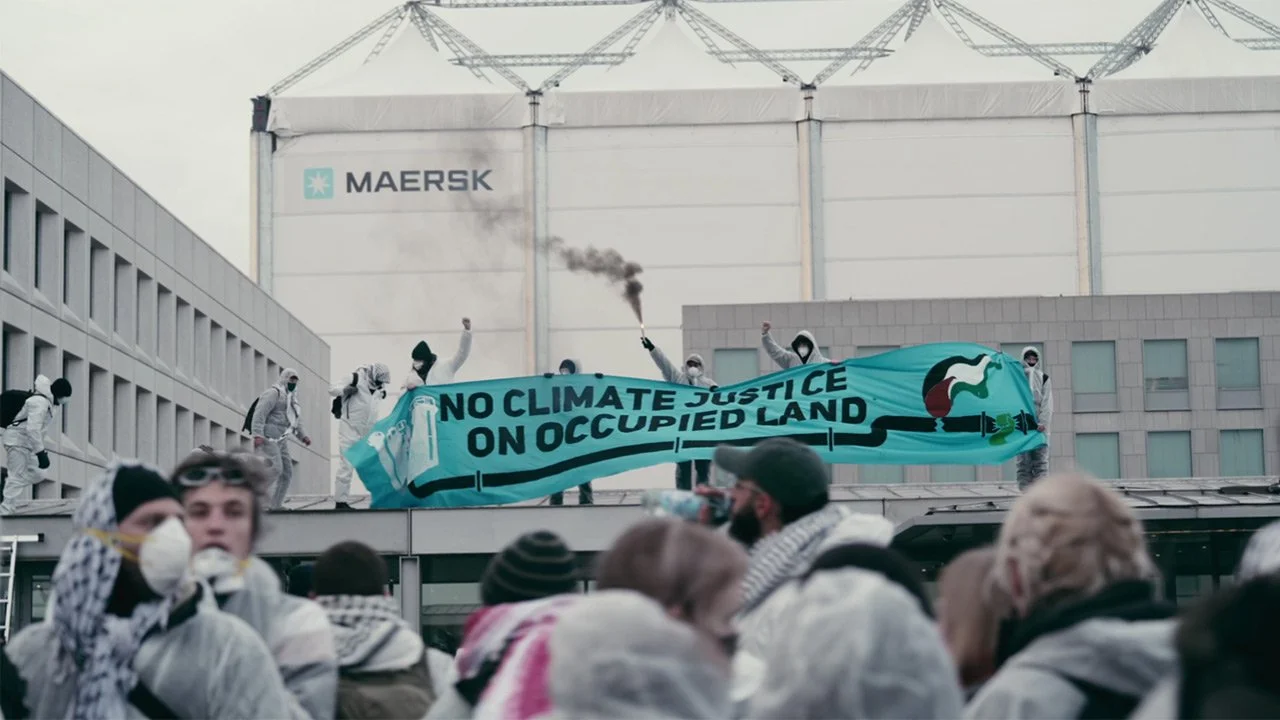
The Cost of Growth (2025)
The capitalist system as we know it is rooted in extractivism. Ecuadorian economist Alberto Acosta defines “extractivism” as a mode of accumulation that began to be established on a global scale with the colonization of the Americas, Africa and Asia by European powers. Since then, formerly colonized regions specialized in the extraction of raw materials, while former colonizers focused on producing manufactured goods. This has led to the “paradox of plenty”: the natural resources of the Global South fuel industrial development and prosperity in the Global North, while their exploitation keeps the Global South impoverished.
Traveling around the world during his youth allowed Belgian film director and activist Thomas Maddens to understand how climate change, extractivism, and colonialism are all part of the same capitalist system that destroys communities and regions. For years, he has tried to fight this system both from behind his camera and on the front lines of activist movements.
On this occasion, Paulina Rosa sits down with him to talk about his latest film, the documentary The Cost of Growth (2025). This is a 90-minute film that challenges the story of Europe’s growth by exposing the extractivist systems it relies on and the damages it causes to several communities. The documentary connects local struggles in Italy, Serbia and Sápmi with broader systemic issues. With an international cast, the movie shows how different communities resist the violence behind Europe’s extractivist economy by building solidarity and activism.
PR: Could you briefly introduce yourself? Who are you? What do you do? What has been your trajectory so far?
TM: I'm Thomas Maddens. My father was a diplomat, so I moved around a lot as a kid and was exposed to a lot of different places and cultures, but also a lot of inequality in the world became clear to me from a really young age.
Film was always something that I was interested in, so I went to film school. I always wanted to make documentaries because once, a friend described it as “the camera is the key that opens all the doors.” That's really how I've lived my life. When I was studying, my main goal was to work for the UN. I started volunteering there, and after graduating I moved to New York to work for the UN. There I was doing humanitarian crisis reporting, so I was going to all the places in the world that were on fire and filming the humanitarian response.
And I started to realize that the UN, but also the world, was looking at these crises in silos. I understood why, but I also started to realize that these mechanisms of why these countries are being impoverished and why these people are suffering are similar in every place. It's basically just a colonial system that has continued. That was the moment I started to shift away from NGOs and UN-type organizations and started to become more politically active. That's when I moved back to Belgium and I started my production company.
I see myself in the first line as an artist, a filmmaker, but always with an activist heart. It's always with the question of, “How can I have an impact? How can I make sure these stories that aren't being told enough see some more light?”
I got involved in the environmental movement right around the time that Fridays for Future, [Swedish activist] Greta [Thunberg] and [Belgian climate activist] Anuna [De Wever] started hitting the streets. And for me it was weird because at that point the climate movement didn't have a really decolonized narrative yet. They were just talking about solar panels and wind turbines. I really came at it with like, “Hey guys, we gotta talk about the mines in Congo and those kinds of things,” because I had seen them.
And just fast-forward a few years, I'm in the climate movement working with Anuna and that was when “degrowth” started becoming a concept that was being thrown around in all its controversy, because it’s obviously not a great term. But then she called me one day and said, “I think we need to make a film about degrowth, and it needs to be something like Cowspiracy, where you just throw this concept into the world to start a conversation.” And that is how The Cost of Growth came to light.
PR: What is The Cost of Growth? What is it about and why should people go see it?
TM: The Cost of Growth is a film about the European economy and the violence it uses to create its riches, and also about the way people are resisting and building alternatives.
I really wanted to tell the story of why Anuna and Lena [Hartog], the two main characters of the film, wanted to make this film. They were on a journey of realizing that the climate movement had lost a lot of its momentum because of so many reasons—Corona, the war in Ukraine and then Palestine, October 7—and kind of reckoning with the fact that the climate movement isn't really a united movement anymore. How do we proceed? And how do we evolve our thinking in that?
So that was the story. And then finding experts, academics, and activists who are on the frontlines of fighting these things. So it's very much like a film that's made from movements, by movements and for movements. But it's also a film that tries to tie all these things together for a mainstream audience [of non-experts] so that they understand the structures of specifically European capitalism, their impact, and how we can build alternatives to them.
PR: I’ve often heard that Greta Thunberg was this golden child, so loved and so popular, she was very respected, and the second she started connecting the dots between climate and colonization, extractivism and the intersection between all of these struggles, she had this massive fall from grace. Do you agree with that narrative? Is this film an attempt to redress that in a way?
TM: When Greta started talking about the genocide in Palestine, a lot of people didn't see or didn't want to see the connections. And I don't necessarily think that the film tries to make the narrative around her better, but it is a way to make clear that if you want to be honest about what climate justice actually means, then you have to look at those intersections and you have to talk about colonialism. I mean, I'm really glad we were able to have some time with her for an interview in the film, because she sees those systems really clearly.
It’s that moment—I think it was in Netherlands [at a climate protest]—when that guy just gets on stage with her and grabs the microphone and says, “I have come here for a climate demonstration, not a political view.” That's such flawed thinking and I would actually love for that person to see The Cost of Growth, because then he’d understand that there's a much bigger story that you need to connect the dots with.
PR: With this film you were documenting a serious social topic. You are an activist, but you are also a filmmaker and artist. When directing the documentary, how important was the artistic aspect of filmmaking for you? What do you think is the value of aesthetics in telling that story?
TM: It was a constant struggle. The amount of information you're getting in the film, there's very little pause, and that's because in 90 minutes we wanted to tell the story of colonialism, capitalism, genocide and all those things. So it was a constant push and pull between wanting to give the viewer all the information but also wanting them to enjoy watching the film.
In that sense, as a director, my main contribution was to make sure that Anuna and Lena’s story was part of the story. That their journey, the questions they were asking at the beginning and the way their character evolved over time were all part of the story. Because without that it's just like a manifest.
I still want a film to look good and to feel good, because I think that's important. That's what I spent all those years before making this film doing: going to the most devastated places in the world but still finding some beauty or some impact and imagery with which you could tell a story.
PR: Rephrase was born as a cultural magazine from the desire to tell new stories. To transform, reshape, or “rephrase” the media landscape of Belgium and the Netherlands by giving new and more critical voices a platform. What are you currently trying to rephrase?
TM: I think one of the things we wanted to rephrase in The Cost of Growth is that the green transition is neither green nor a transition. That it’s just a further aggregation. That was our starting point. When you get all these politicians saying, “Oh, but we're doing better in terms of emissions” and all those things, we’re just not. That's just a blatant lie if you look at the bigger picture.
I think the story of the Sámi people is really important to show that even within Europe there is also still an indigenous struggle going on. It taught me a lot about how the religion of money and capitalism spread and pushed out all those indigenous thoughts and cultures. And that now there's people who are slowly trying to reclaim that back and realizing that if we're connected to the land we need to do these things differently. I knew of that dynamic mostly in East Africa and the Middle East, but to have it be so close… And also visually, for a European audience to see other White people who are indigenous people and are suffering, that helps with a reframe.
Similarly, there was a visual image that needed a reframe, which as a filmmaker, I actually found the trickiest to include in The Cost of Growth: the wind turbine park in Norway and Sapmi. An Israeli company was illegally taking land to build a wind turbine park to power oil drilling platforms. We had a bunch of drone shots of the wind turbine park, and as a filmmaker I had to reckon with the fact that if you're showing an image of a wind turbine park and it looks nice and there's a sun setting and it's beautiful, then most people look at that and think, “Oh, this is a good thing! It's renewable energy.” But actually, the land has been completely destroyed, and the Sámi people can't migrate with their reindeer through there anymore, so that whole ecosystem is getting kind of fucked. So I had to figure out a way to show these images but make people think about them differently. So it was a constant for us, rephrasing things.
PR: You have been very familiar with these issues since a very young age and you built your career around them, so I wonder, what was something new that you learned during the making of this film?
TM: The working-class struggle, because I didn't grow up with it. My dad is a diplomat and a lot of people see that as an elite bubble. I grew up in these weird multicultural international schools, so I never came into contact with factory workers. I learned a lot in The Cost of Growth about that struggle, mainly the pride with which these people look at their jobs. That was really where I was confronted with my own preconceptions. It also made me think more about how I position my activism, who you involve in your activism, and how you make it truly intersectional.
PR: What's next for you?
TM: Continue the activism on many fronts. I do a lot of work on reproductive rights. I actually also want to make a film about mosh pits. Which is interesting, because it sounds really unconnected but for me it's inherently connected. I am interested in how people channel and direct their rage and their anger and where contextualized violence has a place in our societies. Because I feel that if we don't have outlets for violence or anger or rage, then it goes in the wrong places. So that's something I’m working on.
Another big part of my work is that I spent many years documenting survivors of genocide. From the Holocaust, from Rwanda, from Myanmar. I'm always fascinated by the darker topics and I always thought genocide is the ultimate darkness of humanity. How do we get to that point where we've completely dehumanized people? So that's something that I also continue to do. I keep talking about that and keep figuring out how we resist those structures. But then also just continuing things like The Cost of Growth to keep reframing that. Because it's not done that work. It continues.
PR: Where can our readers find The Cost of Growth to see it?
TM: If you go to our website you can see where all the screenings are at the moment. We’ve kind of flipped traditional distribution models on its head. So initially, grassroots and academic institutions are able to do pre-screenings. There's also a couple of film festivals that have selected us, and now we’re doing real deal screenings. And there's also cinemas in a few different countries that are doing screenings: in France, Belgium, the Netherlands and Italy there's a cinematic distribution. Between now and the summer there's gonna be over 500 screenings in I think 150 countries, and they’re easy to find on the website.
PR: Is there anything else you would like to add?
TM: At the end of The Cost of Growth we had to give the edit to another editor at one point because I was directing, filming and editing. I couldn't see it anymore. I got completely burnt out making it and my mental health completely crashed. So I had to get mental health help. But there was something in that moment that actually gave me a lot of hope: when I was coming to group therapy I thought I was gonna be the anti-capitalist activist person, the “radical guy.”
But interestingly, when I talked about capitalism being a really big reason why I was there, a lot of people understood. And these were not activists. There was a factory worker, there was somebody who had a restaurant, there was a nurse, there were just people from all walks of life, and they also understood that this economic system that we function in was a massive reason why they were unhappy. That gave me a lot of hope, because then it brings me back to the idea that if you channel anger and rage in the right direction and you organize around it, then you can actually affect change.
Paulina Rosa is a PhD student at Ghent University and an editor at Rephrase magazine. In her work, she wants to show how the ongoing legacy of our colonial history negatively continues to impact our current reality and to highlight strategies to counter this.
Thomas Maddens is a Belgian filmmaker and activist. He co-founded A Mad Production in Ghent, where he currently works as director and editor. The Cost of Growth is his latest documentary.