Buried, But Not Dead: The Queer Party Thrives Underground
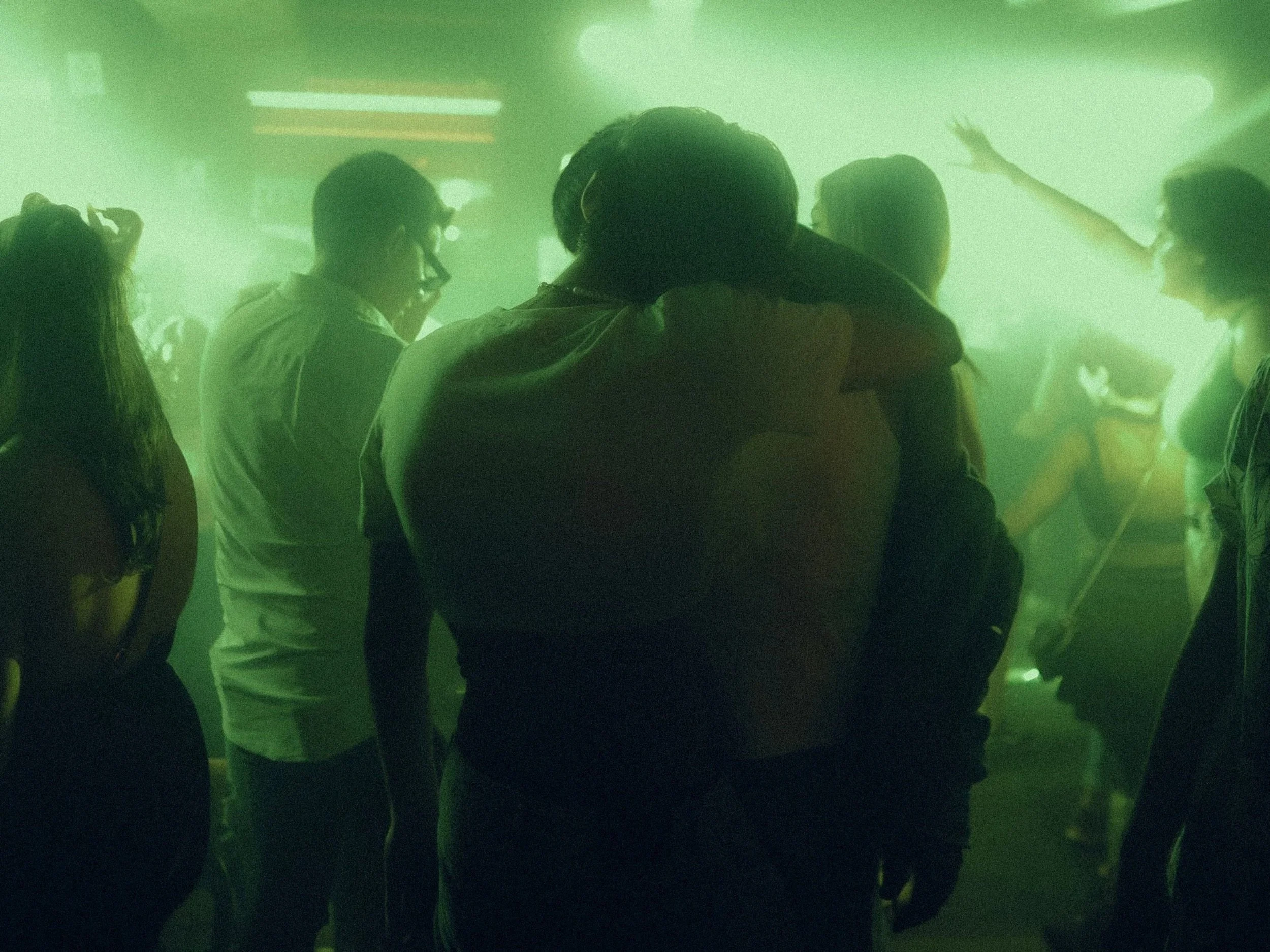
As Amsterdam's queer nightlife evolves, a new wave of grassroots party collectives is reclaiming the dance floor. Livia Wendland explores how these spaces are redefining community, creativity, and resistance after dark.
Amsterdam comes alive at night, swapping posh boutique shops for twenty-four-hour corner stores. Street lights and neon signs glint off the water of the canals in a kaleidoscopic display. Dive bar terraces are packed with locals and tourists alike, and the warehouse raves on the outskirts of the city are surrounded by queues of chain-smoking party-goers, sipping Club-Mate and waxing philosophical about hyperpop music. If you're wondering whether the party will be any good — and increasingly, many of them are not — take note of the number of queer people in line, identifiable by their carabiners, duct-taped combat boots, and graphic eyeliner.
“Across the spectrum, I am often asked the same few questions: Why are there so many straight people here? Why is no one dancing? And why are drinks so expensive?”
As a bartender at a popular queer nightclub, I bike for half an hour into the city center at a time when most people are getting ready for bed. I'm familiar with this crowd of techno devotees, as well as various other expressions of queer identity — from the high femme party princess to the wide-eyed, rainbow-pinned baby gay. Across the spectrum, I am often asked the same few questions: Why are there so many straight people here? Why is no one dancing? And why are drinks so expensive?
Beneath these inquiries lies a more existential question: Where can I find those elusive, authentically queer parties we've all been promised through grainy videos from the early aughts and kinetic analog photos of underground raves from the '80s, when dance floors and ballrooms were buzzing with revolutionary creative energy and political potential?
The popularity and visibility of those parties have diminished, in part, because the intense societal homophobia that once fuelled and necessitated them has also decreased. This shift is most evident in countries like the Netherlands, which celebrated its 25th anniversary of legalised same-sex marriage in April 2026. While intolerance still exists and there is much progress to be made towards true inclusivity, gay nightlife has undeniably become more mainstream, commercialised, and arguably compromised.
In fact, it seems that nightlife as a whole has been declining. Across Europe, many are drafting the eulogy for a club culture that was once countercultural and community-driven. Research shows a global reduction in the number of open gay bars, andmunicipal reports indicate that nightlife has become economically and spatially limited. Online, nostalgic think pieces and TikTok videos lament the lost art of the house party, and tabloids attribute the decline of clubs to phone-addicted, socially withdrawn, and quarantine-stunted Gen Zers.
Despite it all, young people are still very interested in nightlife. We create guilty pleasure playlists for pre-drinks that never happen and put on audacious outfits in our bedrooms that we rarely wear outside. In a world where a vodka cranberry costs as much as a dinner, clubbing has become unaffordable for most Gen Zers, and this is particularly true for queer individuals, transgender people, and racialized minorities, who generally have a lower socio-economic status on average. When we do go out, my peers often purport a sense of emptiness, swaying side-to-side on half-full dance floors, listening to the same limited selection of outdated gay anthems on shuffle.
Amidst this changing cultural tide, we must contend simultaneously with the rapid closure of queer spaces, the commercialisation and depoliticisation of the remaining gay clubs, and a steepening financial barrier to entry.
So, what can a broke, recently graduated queer party girl do?
For many Amsterdammers, the solution lies in niche decentralised queer party collectives and recurring club nights. These initiatives are a beacon of hope in an otherwise bleak nightlife landscape, illuminating pockets of community in strobe lights and glittery disco-ball refractions.
From femme-only raves where Pinterest mood boards set the aesthetic tone and inspire imaginative fashion choices to diasporic parties where DJs spin nostalgic cultural classics with a personalised electronic twist, these events cater to specific tastes that are often overlooked. They transform the dance floor into a space of queer joy, political resistance, and social change.
“Bonding over their shared love for electronic music, FRXCTOSE identified a gap in Amsterdam's clubbing scene for femme, trans, and queer DJs, who deserved to be celebrated as centerpieces of the party rather than as footnotes.”
FRXCTOSE is one such party collective. It was founded by Atzu Tomescu and Cuán Horan Murphy, two master's students who met in a nightlife research group. Bonding over their shared love for electronic music, they identified a gap in Amsterdam's clubbing scene for femme, trans, and queer DJs, who deserved to be celebrated as centerpieces of the party rather than as footnotes. They envisioned a space that would unite club creatures, electronic music nerds, and queer activists – a playful, inclusive environment where everyone would be welcome to explore their identities.
It's also not just Amsterdam. In his 2024 book,Long Live Queer Nightlife, Professor Amin Ghaziani examines how the increasing closure of queer bars has led to a revitalisation of underground nightlife in cities around the world. Ghaziani argues that queer nightlife is not dying; instead, it is evolving to meet the changing needs of a diverse range of interconnected subgroups. The flexible, nomadic, and episodic nature of club nights allows for greater adaptability, community ownership, and cultural specificity.
The reasons for the emergence and popularity of queer club nights are as diverse as their attendees. For starters, these parties offer an alternative space to traditional gay bars, which have historically catered primarily to a white and male clientele. It is from these gay bars that the mainstream queer club emerged, waving the brightly-colored flag of rainbow capitalism. Within rainbow capitalism, queer slang and aesthetics are co-opted for financial gain, nullifying their radical and political origins.
Mainstream queer clubs do, of course, still play an important role in the nightlife ecosystem by offering spaces where queer individuals, non-queer people, and those who are questioning or curious can all come together and socialize. Hailing from a quiet town with lackluster nightlife, the touristy gay clubs of central Amsterdam felt like a safe stepping stone on which I could traverse the murky waters of my burgeoning identity. However, these clubs tend to lack the political ethos necessary for fostering an organic movement or community, instead prioritising profit and mass appeal.
Many of these spaces also fail to adequately address the needs and desires of lesbians, transgender individuals, and queer people of color. According to Professor Ghaziani, alternative club nights not only respond to external homophobia but also to internal hostilities within the queer community, including issues like racism and femmephobia in gay bars.
I vividly remember the excitement of attending my first sapphic club night. It was liberating to step onto a dance floor free from the leering eyes of wall-hugging men or the smug comments of party regulars questioning my right to be there because of my appearance as a femme person. In the smoking area outside, I swapped stories with a variety of like-minded strangers, which expanded my understanding of what it meant — and what it looked like — to be a queer woman.
By catering to specific demographics, club nights curate a specific crowd and foster a sense of acceptance and safety. For example, FRXCTOSE focuses on supporting FLINTA* (female, lesbian, intersex, non-binary, transgender, agender) communities and cultural creatives. According to Atzu, FRXCTOSE often attracts people who feel disillusioned with or excluded from traditional club culture. "They come to these parties to be recharged," Atzu explains, noting that attendees appreciate the unique DIY elements of their parties.
In a city where queer meetups are commonplace, from crafting circles to hiking clubs, and where going on a date is as simple as downloading Hinge and adjusting your preferences based on your orientation, queer club nights still provide a vibrant atmosphere that cannot be found elsewhere. The mood is spontaneous, loud, and unapologetic. Additionally, there is ample opportunity for creative self-expression through fashion, music, and dance.
Whether I'm pouring a long line of Salmari shots at work or taking blurry pictures in the photobooth, I witness entire stories unfold throughout the night. Friend groups merge in the queue with the excitement of colliding galaxies; strangers have sweaty meet-cutes in the corner by the bar; and the DJs engage in a collaborative feedback loop with the audience, mixing sound and rhythm into a colorful, bubbly cocktail.
Regarding artists, Atzu says they have a wish list of established DJs and musicians they would like to invite to future FRXCTOSE events. However, they also prioritize discovering new talent. "We want to work with people whose sound has a sense of urgency to express something new," Atzu explains, as the collective aims to collaborate with those who align well with the party's core ethos.
“Entering an underground party means engaging in a movement — a collective effort to create a temporary oasis in a desert shaped by hegemonic, consumerist thinking.”
For queer club nights, politics and ethos are more than just a catchy slogan. Entering an underground party means engaging in a movement — a collective effort to create a temporary oasis in a desert shaped by hegemonic, consumerist thinking. Atzu believes the roots of queer nightlife lie in activism and emphasizes the importance of honoring that legacy by fostering spaces where social norms can be challenged.
The queer club night can maintain an explicitly political stance, unlike traditional venues that must remain appealing and safe for investors while attracting a large audience. In contrast, collectives like FRXCTOSE operate on limited cultural funding and the enthusiasm of volunteers. They set ticket prices and drink costs on a flexible sliding scale to accommodate attendees' varying financial situations, while still ensuring that artists and performers are fairly compensated.
The latest edition of FRXCTOSE took place on Labor Day. It blended elements of protest and celebration, beginning with an educational monologue about workers' rights and the need to de-stigmatize sex work. The speech was followed by several glamorous, cheeky cabaret performances by Full Service Production, a collective of queer sex workers from the Redlight District, who collaborated with FRXCTOSE for this special event.
Atzu smiles, recalling how, after a communal home-cooked meal, the volunteers came together during the tense final hour before the Labor Day event to narrowly avoid a last-minute sound system failure. The room quickly came to life: beer flowing, bass thumping through the speakers, and an analog camera ready to capture the entire evening. The doors swung open, and the night began to fill with clubgoers adorned in glittery eyeshadow and mesh tops.
Like a bolt of electricity, queer party collectives are revitalising a stagnant nightlife culture by providing an alternative to commercialised gay bars, creating a safe space for overlooked communities, and offering a platform for emerging talent. If you're looking for a place to dance and bare the parts of your soul you usually keep hidden during the day, start searching obscure venue listings and Instagram announcements for grassroots initiatives. Pay attention to sticker tags in the bathroom stalls of queer hotspots, and follow the trail of recurring parties as they move between canalside venues and industrial courtyards in drag makeup and too-high heels.
Amsterdam has something for everyone — if you know where to look.
Writer by day and bartender by night, Livia Wendland is a Political Science graduate based in Amsterdam. Her work covers a wide range of topics, from local activism to niche internet subcultures. She aims to highlight the interplay between the personal and the political through social commentary and empathetic storytelling, always incorporating a touch of whimsy.