What the Epstein Files Reveal About Trump, Power and Loyalty
In this analysis, writer Livia Wendland examines what the Epstein files reveal about Donald Trump, political loyalty, and the dynamics of power within the MAGA movement.
It is July 8, 2025, and a cabinet meeting is underway at the White House. U.S. President Donald Trump sits before golden curtains and American flags, responding to questions from reporters. One topic, has haunted his presidency, sticking like a stubborn thorn in his side. He becomes visibly irritated when a reporter presses further.
“Are you still talking about Jeffrey Epstein?” Trump says with thinly veiled impatience. “This guy’s been talked about for years. Are people still talking about this guy? This creep? That is unbelievable.”
Donald Trump’s long-standing connections to Jeffrey Epstein and his administration's refusal to release relevant documents have raised concerns across party lines. As the world awaits answers, one must wonder why the Epstein files have garnered such public interest and divided the Republican Party to a degree that few of Trump’s previous scandals have managed to do.
Who was Jeffrey Epstein?
But first, who was Epstein, and why has his name become synonymous with Trump? Jeffrey Epstein was a wealthy American financier once known to the public as an eccentric socialite, mingling with royals, politicians, and celebrities alike. He is now remembered as a notorious sex criminal.
In the early 2000s, Epstein strung together a secretive network of underage girls, trafficking and sexually abusing them at his lavish homes in Florida, New York, and the Caribbean. According to victim reports, he targeted vulnerable teenagers and pressured them to recruit other young girls, promising assistance with their finances, education, and careers. He also coerced his victims into performing sexual acts with his equally wealthy associates.
Association alone does not prove guilt, but such a large sex trafficking ring, involving hundreds of girls and young women, would require the participation and silent consent of many of the world’s most powerful individuals. However, to date, only one other person has been convicted of crimes related to Epstein: his right-hand woman, co-conspirator, and former girlfriend, Ghislaine Maxwell.
Jeffrey Epstein’s elite social circle included prominent figures such as former U.S. President Bill Clinton, British royal family member Andrew Mountbatten-Windsor, and celebrities like Michael Jackson and David Copperfield, among others. Notably, it also included Donald Trump.
In the 1990s, Donald Trump, a wealthy real estate developer, and Jeffrey Epstein, a hedge fund manager, moved in the same circles in Manhattan and Palm Beach, Florida. Grainy party videos and wedding photos capture their casual camaraderie. In 2002, Trump referred to Epstein as a good friend of fifteen years, describing him as a “terrific guy” with whom he had a mutual appreciation for beautiful women — many of whom, as Trump slyly noted in the same interview, were “on the younger side.”
Trump and Epstein eventually had a falling out. By 2005, Epstein was under investigation for sexually abusing underage girls. Due to a controversial plea deal arranged by former federal prosecutor Alexander Acosta — who was later appointed Secretary of Labor by Trump — it wasn't until 2019 that Epstein was finally indicted on federal sex trafficking charges in a Manhattan court.
On August 10, 2019, Epstein died while in custody, awaiting trial. His death was ruled a suicide.
The files and the promise of transparency
Jeffrey Epstein left behind numerous unanswered questions and lasting consequences for his victims. The circumstances surrounding his life and death fueled conspiracy theories centered on the Epstein files — documents generated from criminal investigations and civil lawsuits. Some were unsealed during court proceedings initiated by victims like Virginia Giuffre, Courtney Wild, and Annie Farmer, who bravely shared their stories of abuse. However, many documents remain classified.
During his presidential campaign, Trump asserted his innocence regarding the scandal and promised to fulfill the public's demand to release the files.
For years, the MAGA movement, which stands for “Make America Great Again,” and its right-wing media apparatus have emphasized the importance of the files to Republican voters. Through conspiracy theories like Pizzagate, MAGA supporters have been primed to believe that high-ranking Democrats were involved in a child sex-trafficking ring. They believed an Epstein client list would prove Trump's innocence and implicate his enemies.
And so, Trump was re-elected, with years of intrigue building towards an ultimate crescendo. Supporters and critics waited to see if he would fulfill his promises.
Backpedaling and redactions
Cue the backpedaling — and the media circus.
From Attorney General Pam Bondi's blunder on Fox News, claiming the Epstein client list was sitting on her desk for review, only to retract her statement later and announce there was no client list, to Trump's rambling that the files were written by Barack Obama and Hillary Clinton, the Trump administration seemed to be trying to have it both ways: insisting that the president had nothing to hide while simultaneously refusing to release any relevant documents. Trump described the the files as “sordid but boring” and silenced reporters with insults like “quiet, piggy.” He also criticized his supporters for calling for transparency, labeling them “stupid Republicans” who were being deceived by a Democratic hoax.
Meanwhile, The Wall Street Journal published a birthday card allegedly written by Trump to Epstein, concluding: “A pal is a wonderful thing. Happy Birthday — and may every day be another wonderful secret.”
The Trump administration quickly denounced the letter as fake, despite evidence to the contrary. During an interview with a Trump-appointed attorney from prison, Maxwell stated she did not remember compiling Trump's letter for a collection of birthday cards. Of course, people in prison are typically hesitant to testify against the president, and just a week after her interview with the Department of Justice, Maxwell was transferred to a more comfortable minimum-security prison.
Democrats on the House Oversight Committee proceeded to release several emails exchanged between Jeffrey Epstein and Ghislaine Maxwell. In an email from 2011, Epstein writes to Maxwell: “I want you to realize that the dog that hasn’t barked is Trump… Virginia spent hours at my house with him.” In another email, Epstein stated: “Trump knew of it, and came to my house many times during that period.” He also added, “He never got a massage,” presumably in reference to coerced sex acts.
Though the emails certainly do not paint a good picture for Trump, they do not directly incriminate him, as Virginia Giuffre — who died by suicide in 2025 — never explicitly accused the president of any wrongdoing.
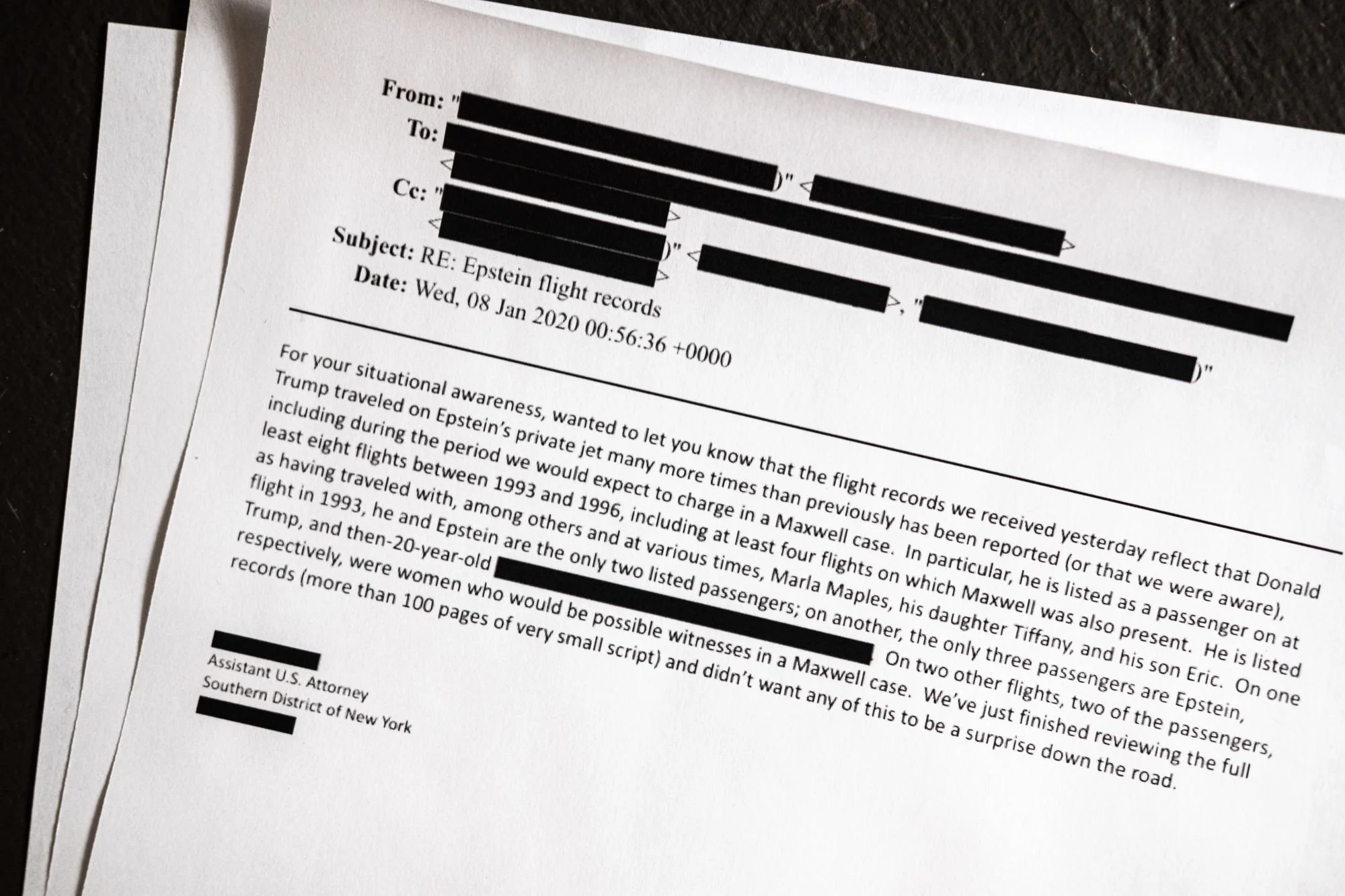
In another turn of events, Congress overwhelmingly voted to pass the Epstein Files Transparency Act, which mandates that the Department of Justice release all unclassified documents related to the Jeffrey Epstein investigation. However, the government can still redact information to protect the identities of anonymous victims and to prevent the dissemination of child pornography. They can also withhold certain details under the vague guise of “national security.”
As expected, the government generously exercised this redaction power — releasing numerous pages filled with blacked-out content. Out of the millions of files reportedly awaiting review by the Department of Justice, only 12,285 documents have been released as of January 2026, over a month after Congress's original deadline.
Cognitive dissonance and the limits of political devotion
Throughout this story, many of Trump's supporters expressed uncharacteristic frustration. For years, Trump has fostered distrust in institutions, predisposing his base to believe in government cover-ups and conspiracies. His evasive, irritable, and contradictory behavior regarding these files feels incompatible with the openly abrasive president they have come to admire. Instead, it resembles the secretive politicians they have grown to hate — the kind of politician who might be capable of, and complicit in, protecting powerful pedophiles.
It begs the question: for a support base conditioned to accept a baseline level of cognitive dissonance, why has this particular inconsistency been so difficult to swallow? No matter the scale or shock of previous scandals, the most vocal MAGA supporters continue to back Trump with near-religious fervor, even as he consistently fails to deliver on his promises or make material improvements in their lives. This is because it’s not about what Trump does or doesn’t do; it’s about what he represents.
Trump has strategically seduced his voters, primarily comprised of white rural and suburban Christian voters, by acknowledging their concerns, which include anxieties about changing demographics, declining religious belief, rising living costs, and the transition from a manufacturing-based economy to one that favors urban white-collar professionals. Additionally, he has rallied his supporters against a convenient set of scapegoats, such as immigrants, transgender people, and foreign actors — pointing the finger anywhere but at his peers in the billionaire club.
Moreover, the GOP has found that MAGA voters are attracted to the aesthetics of private jets and old white men in suits, of star-bangled patriotism resplendent with guns, picket fences, and maple pancakes. Dissatisfaction with the present turns into rose-colored nostalgia for an idealized past, a re-imagined history defined by righteous Christian nationalism and uncontested U.S. hegemony. Make America “great” again.
These voters trust Trump because he presents himself as an atypical politician — brash, combative, and wrapped in the image of a wealthy patriot. As long as that image holds, inconsistencies are overlooked.
This is the cognitive dissonance at play. Trump can be celebrated as a “man of the people” while also being admired as a New York billionaire and TV personality. He has built a reputation as someone who works hard and plays harder. By paying lip service to conservative talking points, he can be perceived as a good Christian man and a champion of traditional values, despite facing countless allegations of sexual misconduct and having made many hateful, misogynistic, and racist remarks.
Trump is a walking contradiction, thriving on bombast and scandal. Each controversy seems to wash away like water off a toupeed duck's back.
Sex trafficking, however, does not fit neatly into this carefully crafted image. It's difficult to spin the sexual exploitation of minors as part of the Trumpian brand, unlike other atrocities which have been dismissed as locker room talk or war room strategy, regarded as displays of power and force.
There are certainly large segments of his voting base that would continue to support the president unwaveringly, come hell or high water. Being a morally sound person has never been a prerequisite for political success — in fact, the opposite may be true, as the ranks of our world leaders are riddled with sex offenders and war criminals. However, the water is rising awfully high, and the man who once boasted he could shoot someone on the street without losing a single voter may be pushing his luck to its limits.
Cracks are starting to appear within the Republican Party as well. Former Congresswoman Marjorie Taylor Greene, who entered Capitol Hill as one of Trump’s staunchest supporters, has since become one of his most vocal critics and has resigned from her position after condemning the president's refusal to release the files. Republican legislators are pushing back against the president’s redistricting plans, and Fox News anchors are correcting his false statements.
A Vanity Fair article featuring interviews with some of Trump’s core personnel, including Vice President JD Vance and Chief of Staff Susie Wiles, reveals a cabinet that is more dysfunctional and less united than they would like the public to believe. Although these acts of disagreement and petty displays of infighting may seem minor now, they would have been considered career suicide just a few years ago.
The narrative battle
Is this the end of the MAGA movement? Probably not, at least not anytime soon. Regardless of what information might emerge from the Epstein files, many of Trump's supporters will deny any wrongdoing and remain loyal to the narrative they have invested so much political and personal belief in. Some, however, will gradually distance themselves from the movement as their cognitive dissonance dissipates. Opportunistic Republican politicians will continue to test the strength of Trump’s iron fist, seeking to fill the power vacuum that will inevitably emerge within the party.
In the meantime, Trump will keep trying to take control of the narrative, the one scandal he cannot seem to escape — but the story only fades away if the public allows it to. A thread has come undone in the administration’s facade of contradictions and patriotic bravado, and we must keep pulling at it until it unravels.
We cannot let people like Epstein — who use their wealth and influence to exploit women and girls — to disappear from public consciousness. We must ensure that his accomplices do not remain unnamed, hidden behind blacked-out bars in the justice department’s files.
In the words of the late Virginia Giuffre: “The way he [Epstein] viewed women and girls — as playthings to be used and discarded — is not uncommon among certain powerful men who believe they are above the law. And many of those men are still going about their daily lives, enjoying the benefits of their power.”
So, to return to Trump’s question: Are we still talking about Jeffrey Epstein? Yes, we are — not because we want to, but because we must.
Writer by day and bartender by night, Livia Wendland is a Political Science graduate based in Amsterdam. Her work covers a wide range of topics, from local activism to niche internet subcultures. She aims to highlight the interplay between the personal and the political through social commentary and empathetic storytelling, always incorporating a touch of whimsy.