Between Disappearance and Return in Yunan
Sprouts Film Festival ‘26. eco competition
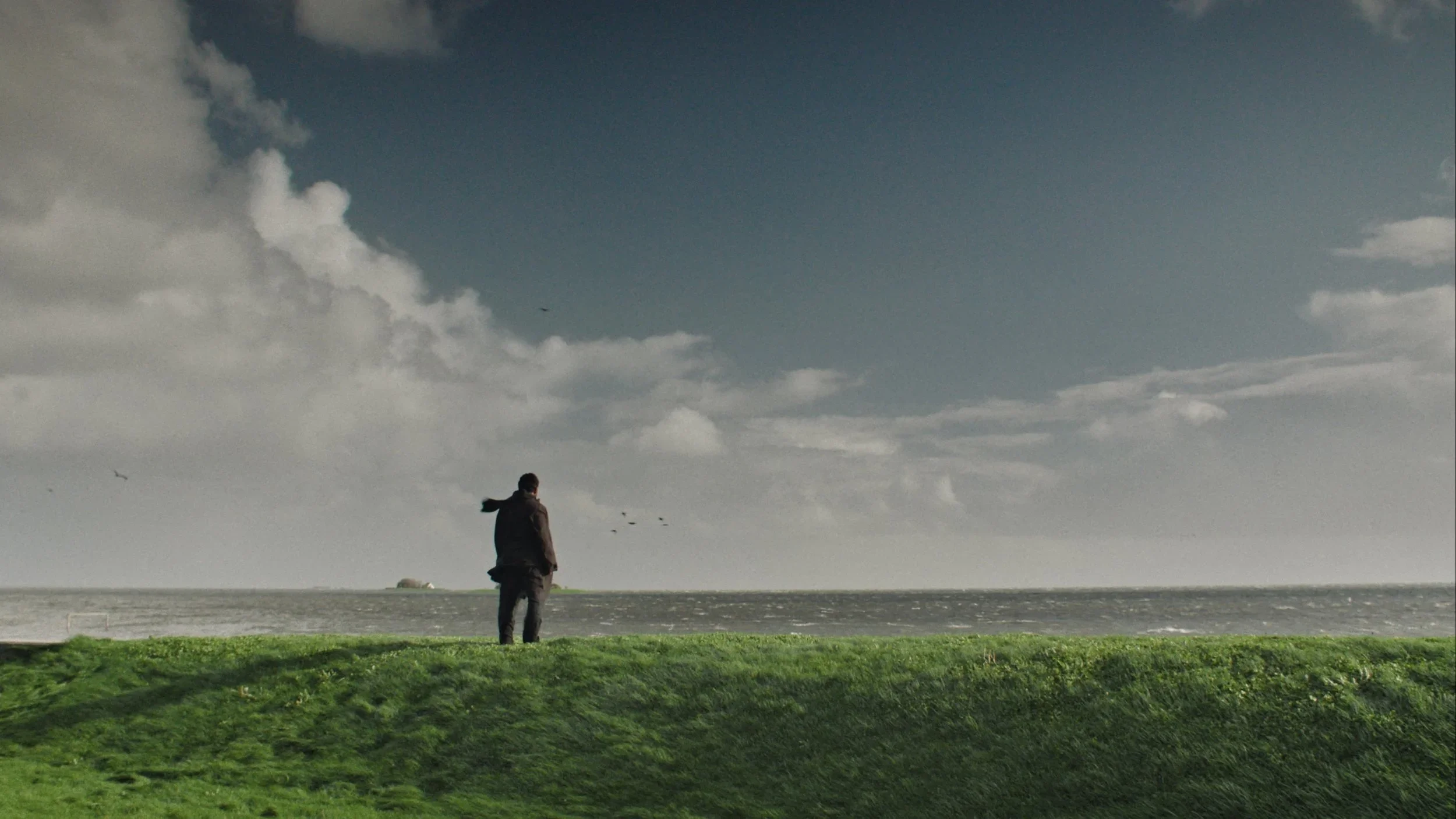
© Yunan (2025) by Ameer Fakher Eldin
Selected for the Eco Competition at the Sprouts Film Festival, Yunan (2025) by Ameer Fakher Eldin, watched by Liza Kolomiiets, combines thickly painted landscapes, subtle mythological tropes, and an unlikely relationship formed amid an all-consuming storm.
What if, instead of gasping for more air, craving full understanding and longing for acceptance, we connected through silence? Yunan does not offer a clear answer to this question, but creates space to search for it within ourselves.
Rooted in slowness and poetic meditation, Yunan tells a story of a person in exile. Munir (Georges Khabbaz), the terse protagonist with a piercing yet melancholic gaze, is a lonely writer living in Hamburg. It is not entirely clear which part of the Arabic world he is from, nor what the exact reasons for his displacement are. Despite his intimate relationship with a German woman or his warm phone calls with a sister and a heavily demented mother, Munir seems entirely disconnected from the world.
After the doctors are unable to diagnose the reasons for Munir’s shortness of breath, he decides to take a trip to the Hallig Islands off Germany’s austere northern coast, with a plan to take his own life. There, on what seems to be the end of the earth, he meets the enigmatic owner of a remote inn. Valeska (Hanna Schygulla) is a quiet yet direct elderly German woman who runs the guesthouse together with her only son Karl (Tom Wlaschiha). Even though the first encounter between Valeska and Munir is far from smooth, the two quietly develop a bond as the big storm leads to the ‘Land unter’ phenomenon, where the sea temporarily swallows the land.
“Fragmented dreamlike sequences in a copper hue exist parallel to the reality of the protagonist.”
The themes of temporality, disappearance and reemergence, submersion and return, are also evoked by the symbolic tale of a shepherd with no mouth, no ears, and no eyes, told by Munir’s mother. Fragmented dreamlike sequences in a copper hue exist parallel to the reality of the protagonist. Appearing as an echo of a past life that never really existed, the sequences resist progression, letting the viewer drift off.
Returning to places one never truly left, the liminal sequences blur memory, fantasy, and longing. Exile occurs as separation from place as much as the gradual erosion of memories that once anchored identity. While the dreamlike interludes beautifully convey the cyclical nature of memory, their repetition occasionally flattens the emotional progression, causing the film to linger on feelings it has already communicated through image and sound.
The title Yunan, the Arabic name of the Prophet Jonah, quietly echoes throughout the film. Much like Jonah's descent into the belly of the whale, Munir's arrival on the Hallig Islands feels less like a journey toward escape than a retreat into a space of suspension. Surrounded by water and stripped of direction, he inhabits a threshold between disappearance and return, where despair and hope become difficult to distinguish.
“Recurrent framing through doorways turns Munir into a figure perpetually observed yet unreachable, creating a sense of isolation, loss, and fear.”
This state of suspension is also reflected in the film's visual and sonic language. Fakher Eldin barely offers a traditional backstory of the characters, but meticulously paints their emotional landscape instead with the help of director of photography Ronald Plante. Recurrent framing through doorways turns Munir into a figure perpetually observed yet unreachable, creating a sense of isolation, loss, and fear. Kuen-Il Song's restrained sound design that foregrounds heavy breathing and the relentless winds outside immerses the viewer in the subtle physicality of anxiety.
The feeling of unease and constraint invoked in nearly every indoor scene is frequently contrasted with the outdoor scenes, where the vast natural landscapes seem completely unbothered by the human presence. The ripples of the lush grass, the magnificence of the large bodies of water, and the infinite sky greys shown by slow camera pans accentuate nature’s indifferent rhythm with a backdrop of a man’s inner turmoil.
Manifesting itself in the silences between the film's sparse dialogue, Fakher Eldin invites both Munir and the viewer to embrace "less" rather than "more" as an emotional anchor and means of connection. In a world obsessed with expansion, explanation, and certainty, Yunan finds solace in contraction.
Liza Kolomiiets is a Ukrainian researcher and critic based in the Netherlands, working across film, fine art, and media. Her work focuses on themes of displacement and exile, while her curiosity extends to a wide range of visual forms and artistic expressions.