COLUMN / Uncertainty, Dependence and Loneliness: Re-remembering Childhood with Cría cuervos
In her bi-weekly film column, Liza Kolomiiets follows the films that linger with her, using them as starting points to explore memory, identity, and the world around us. This time, she returns to Carlos Saura’s Cría cuervos (1976), a film about childhood and uncertainty that, 50 years after its release, still speaks to the anxieties of the present.
Very often, when the responsibilities of adulthood become overwhelming and uncertainty becomes more prominent, I think to myself about how carefree and easy it was to be a child. In my fragmented memory, even in difficult times, life seemed to be much easier to navigate. At least that’s what I thought until I watched Carlos Saura’s Cria cuervos (Raise Ravens), a Spanish film, whose fiftieth anniversary is being celebrated with a theatrical re-release.
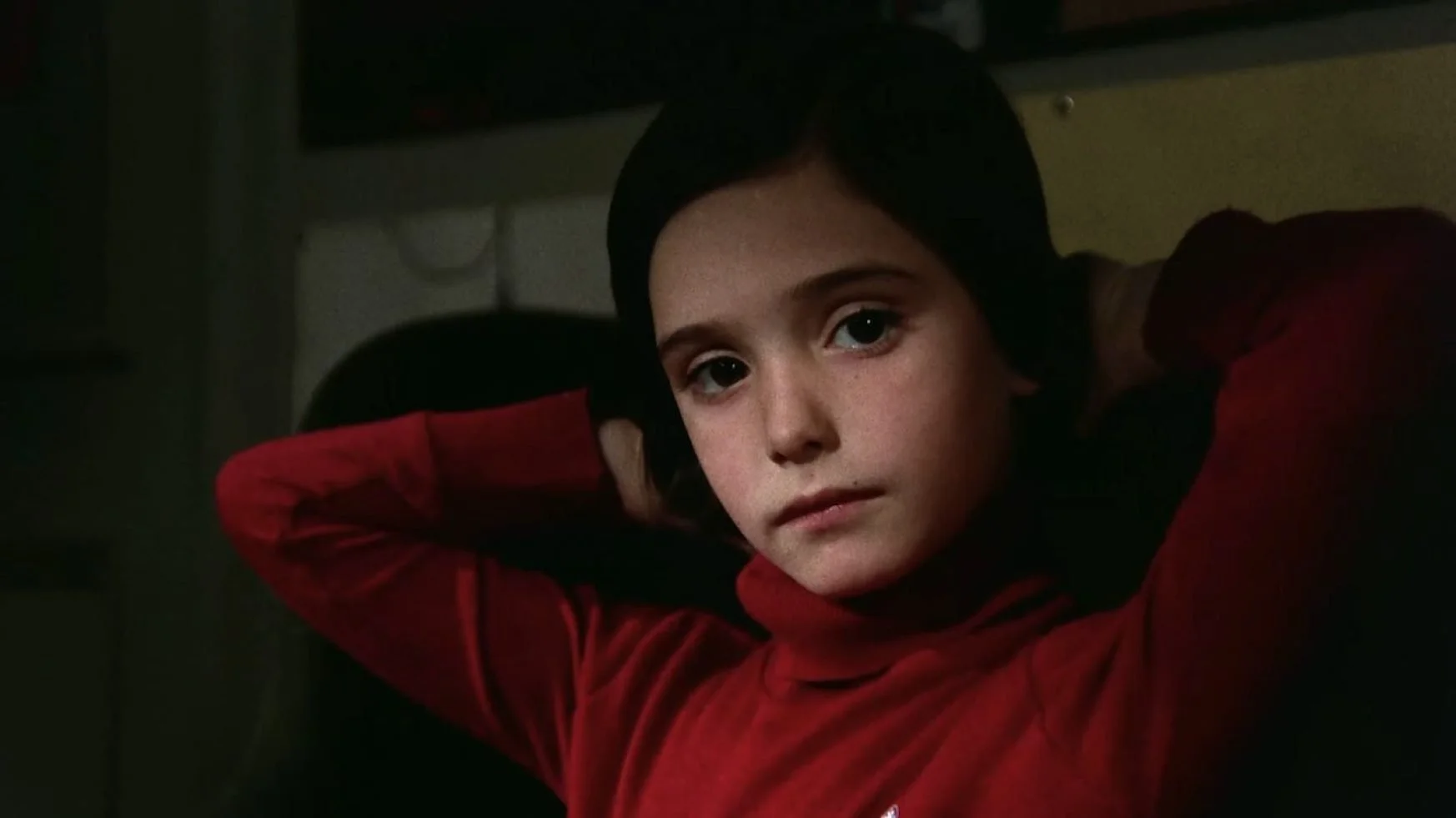
While many directors tend to romanticise childhood, Saura does nearly the opposite. Cria cuervos begins with an eight-year-old Ana (Ana Torrent) encountering both her ruthless father’s infidelity and sudden death, leaving Ana and her sisters orphans to be guarded by their cold aunt. Ana creates her own world, where her mother was not ill and did not pass away, and where death itself becomes strangely straightforward.
The film seamlessly weaves together multiple timelines: that of Ana’s past, when her parents are still alive; her present, when grappling with loneliness and uncertainty becomes too much; and her future, in which adult Ana (Geraldine Chaplin, who also plays the mother in the film) shares her thoughts on childhood. Without warning the viewer, Saura blends the imagined with the real, desires with fixations, never fully opening the door to the mysteries of one’s childhood.
The film’s purposefully awkward camera angles, slow pan shots, and almost haunted empty spaces give plenty of breathing space for contemplating your own childhood, no matter how difficult or carefree it may have been. Ana Torrent’s brilliant performance, especially in moments when she breaks the fourth wall with a piercing stare, leaves you in a trance-like state, where staring right back at her is both voyeuristically uncomfortable and strangely soothing. All of a sudden, I remembered what it was like to be constantly told what to do, where to go, and how to behave by adults who often seemed as confused as I was.
“The family home becomes a miniature version of a country trying to reckon with what a dictatorship has left behind, while its women navigate the expectations imposed on them by the world around them.”
Cria cuervos is also deeply rooted in the political and social reality of late-Francoist Spain. The family home becomes a miniature version of a country trying to reckon with what a dictatorship has left behind, while its women navigate the expectations imposed on them by the world around them. Death, trauma and repression linger beyond the events that caused them, shaping the lives that continue afterwards. Saura captures this with remarkable subtlety. Yet, the reason this fifty-year-old film is worth revisiting today is not simply that it is a renowned classic, but because Cria cuervos is an unusually honest film about navigating uncertainty.
Ana’s uncertainty feels particularly familiar now. Growing up has always meant being unsure of what comes next, but for many young adults today, that feeling seems to stretch far beyond the ordinary anxieties of adulthood. Political instability, economic insecurity, wars, and the increasingly difficult idea of planning a future can make adulthood feel less like a destination and more like something we are improvising our way through. In that sense, Ana’s world does not feel as distant as the film’s age might suggest. She is trying to make sense of circumstances that are much bigger than her, using the only tools available to her – imagination, memories and the strange logic of childhood.
That is also why the film’s use of music feels so poignant. Jeanette’s Porque te vas returns throughout the film with its deceptively catchy, almost carefree pop sound, while its lyrics evoke a mysterious sense of departure and loss. It is both nostalgic and strangely immediate, much like the childhood Saura depicts. The song gives Ana’s world a sense of lightness without ever allowing us to forget what lies underneath it.
Watching Cria cuervos made me realise that perhaps I have been remembering my own childhood incorrectly. Not because it was necessarily unhappy, but because childhood was never as carefree as I now imagine it to have been. I was simply too young to recognise how much uncertainty was already there. Adults decided where I went, what I did, and what I was supposed to understand, while I tried to make sense of a world whose rules were rarely explained.
“The child who once struggled to understand the world has not disappeared, they have simply grown older, learned a few more rules, and found new things to be uncertain about.”
So perhaps, when adulthood becomes overwhelming, the answer is not to romanticise the childhood we think we have lost. Cria cuervos reminds us that childhood was complicated too. The child who once struggled to understand the world has not disappeared, they have simply grown older, learned a few more rules, and found new things to be uncertain about. Maybe that is why Ana’s stare feels so unsettling: somewhere behind it is a child we may recognise, because we have never completely stopped being that child.
Cria cuervos will be screened in independent (Cineville-eligible) cinemas around the Netherlands and Belgium until October 13th.
Liza Kolomiiets is a Ukrainian researcher and critic based in the Netherlands, working across film, fine art, and media. Her work focuses on themes of displacement and exile, while her curiosity extends to a wide range of visual forms and artistic expressions.